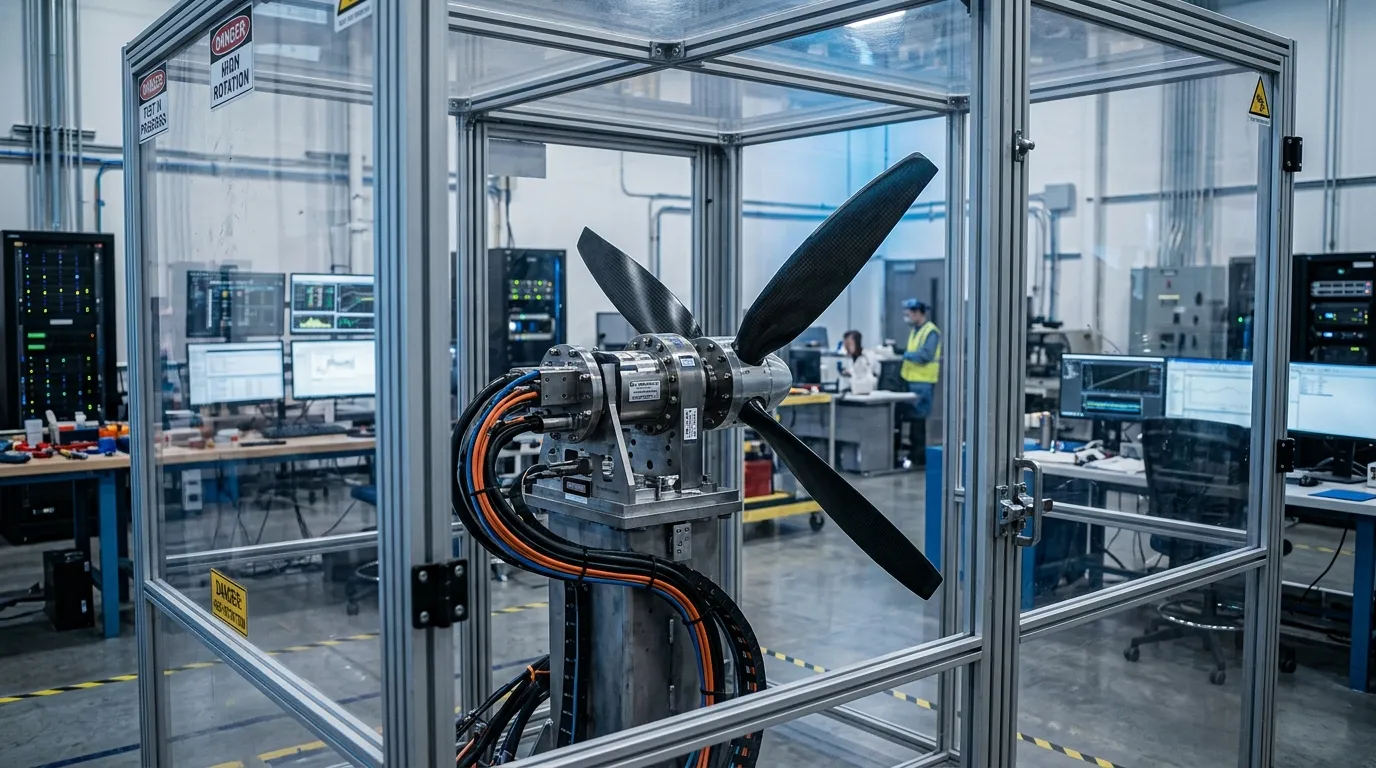
Define the comparison question first
A propeller that produces more thrust will not necessarily do the same mission more efficiently. It may draw more power or push the motor beyond its continuous operating limit. First decide which condition is being compared: equal thrust, equal power, equal RPM or equal flight speed.
For example, if the thrust the platform needs in cruise is known, the power each candidate needs to deliver that thrust becomes important. At takeoff, short-duration maximum thrust and system limits are evaluated. Different questions cannot be answered with a single maximum value.
Separate electrical power from shaft power
In an electric test system, the voltage and current measured at the controller input give the electrical input power. Mechanical power at the motor shaft is the product of torque and angular speed. If speed is measured in revolutions per minute, conversion to seconds and radians must be made when calculating mechanical power.
At a representative measurement point, 24 V and 20 A amount to 480 W of electrical input power. A simultaneously measured 0.60 N·m of torque at 6,000 rpm corresponds to about 377 W of shaft power. In this example, the ratio of shaft power to input power is about 79 percent. Within the measurement boundaries, this ratio represents the combined conversion performance of the motor and controller; it is not the aerodynamic efficiency of the propeller.
Static thrust per watt is not a dimensionless efficiency
In a static test, the propeller accelerates the surrounding air while mounted on a fixed rig. The ratio of thrust to power consumption can be useful for comparing candidates running under the same conditions. However, this value, expressed in N/W or gf/W, is not a dimensionless efficiency expressed as a percentage. It should also be stated whether the power used is electrical input or shaft power.
In forward flight, classical propeller efficiency is defined as the product of thrust and forward speed divided by shaft power. In the static case, forward speed is zero, so this definition gives zero. That does not mean the propeller is useless; it shows that static and forward-flight performance cannot be described with the same metric.
Test conditions are part of the results
Air density, temperature, battery voltage, motor condition and nearby flow obstructions can affect the measurement. If the propeller is close to the rig structure or a wall, flow conditions can change. Rather than directly comparing catalog values for two candidates taken in different environments, measuring them under common conditions is more meaningful.
Throttle percentage is not a universal operating point either. The same command can produce different RPM with different motor–controller combinations. For a comparison, actual RPM, voltage, current, thrust and, if possible, torque should be recorded over the same time interval. Steady-state measurements should be separated from data taken during acceleration.
Use curves and repeats instead of a single value
Thrust–power and thrust–RPM curves show how a propeller behaves at different operating points. The performance ranking of two candidates can change between the low- and high-thrust regions. If most of the mission time is spent at low power, focusing only on the peak point can lead to the wrong choice.
Sensor calibration, zeroing and repeated measurements also matter. A small observed difference may lie within measurement uncertainty or test-to-test variation. When evaluating results, look not only at the average but also at the spread of repeats and the measurement limits. Transferring static test results to forward flight should be verified separately.
Tulkas's test-driven approach to propellers
Tulkas approaches propeller development together with mission requirements, geometry, material and test feedback. The measurements to monitor and the verification scope are defined according to the project's goals. The aim is to achieve meaningful and repeatable performance at the platform's operating points rather than a single impressive thrust figure.
Frequently Asked Questions
Is a propeller that produces more thrust in a static test also better in flight?
That cannot be concluded directly. When forward speed changes, the propeller's operating conditions change too. For cruise performance, the relevant speed and RPM range should be evaluated. A static test is a useful input for takeoff and initial comparison.
Can a gf/W value be used as a percentage efficiency?
No. gf/W shows thrust in gram-force per unit of power and is a dimensional quantity. A percentage efficiency is a ratio of two powers. The report should clearly state the definition of the metric and the point where power was measured.
Is comparing at the same throttle percentage enough?
Not on its own. The relationship between the throttle command and actual RPM and power depends on the system. A comparison goal such as delivering the same thrust or using the same power should be chosen, and the evaluation should be based on real measurements.
How is a small performance gain verified?
It requires common test conditions, calibrated measurement, repeated trials and an uncertainty assessment. If the difference can be separated from measurement variability, the conclusion is stronger. It also matters that the gain holds across the relevant operating range of the mission.
Let's interpret your existing measurements together
Share your test data with Tulkas along with your motor, controller, battery and propeller details. Let's define the comparison and development scope together based on the target operating point.