When is an off-the-shelf propeller enough?
Catalog propellers provide a fast and economical starting point during prototype development. Using an off-the-shelf product to get the motor running, try out the control algorithm and carry out the first flights is often the right call. The problem is when the propeller selection is left as-is from the first prototype even after the platform has matured.
An off-the-shelf propeller is designed to appeal to a broad user base. It cannot be expected to be optimized for your specific motor winding, battery voltage, airframe clearance, cruise speed and mission payload. Once the platform turns into a commercial or mission-critical product, the propeller must also be reconsidered at the system level.
The starting point of custom design: the requirements set
A platform-specific propeller effort begins not by drawing geometry but by defining measurable requirements. Target thrust, operating RPM, motor torque, power limit, maximum diameter, cruise speed, noise target, environmental conditions and mission duration are the basic inputs.
There is often conflict among these inputs. Higher thrust may require more power; reducing blade tip speed for lower noise may increase the diameter requirement; compact packaging may require more blades. The value of custom design is making these conflicts visible and resolving them according to priority.
Motor and propeller must be designed together
The catalog power rating of an electric motor alone is not enough to select a propeller. The motor's continuous and short-term torque capacity, efficiency map, cooling, ESC limit and battery voltage determine the operating point. If the propeller overloads the motor, RPM drops and current and temperature rise. If it underloads the motor, the motor may run at high RPM without achieving the expected thrust.
The goal of custom propeller design is not just to spin the motor, but to keep it in an efficient and safe region for the significant portion of the mission. This is why data exchange between the motor manufacturer and the propeller developer is critical.
Aerodynamic geometry is not just diameter and pitch
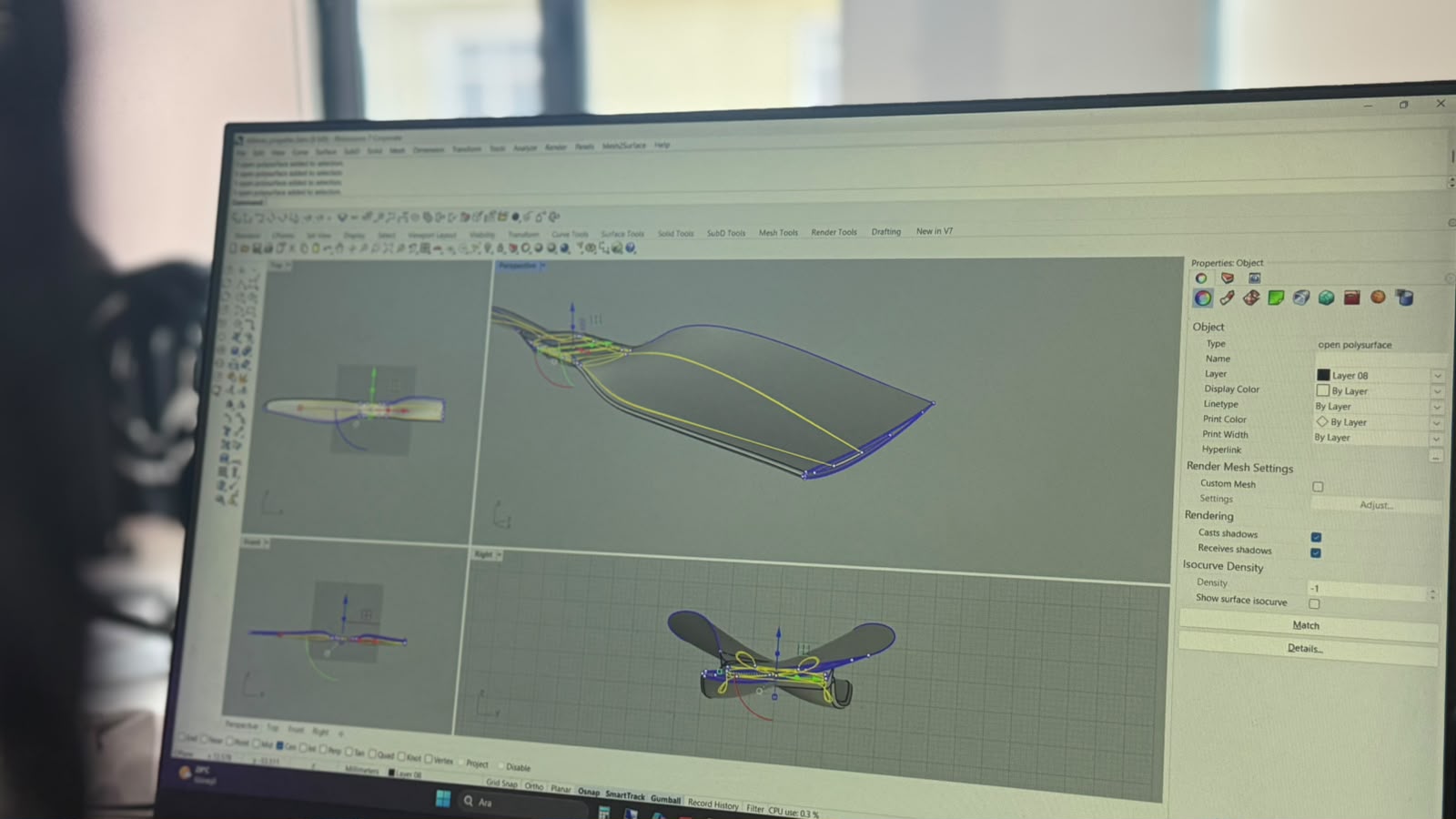
Profile thickness, camber, twist, chord distribution, sweep, tip geometry and root transition all vary along the blade. Since each cross-section operates at a different circumferential speed, designing every region of the blade with the same angle is not efficient.
The blade root is also a structural region, not just an aerodynamic one. Loads are transferred to the connection, and geometric transitions affect stress concentrations. Good design evaluates aerodynamic performance, blade deformation, fatigue and production method within the same model.
Manufacturability is part of the design, not the last step
A geometry that looks good digitally can cause problems in series production if it doesn't release from the mold cleanly or prevents the plies from seating properly in the root region. Blade tip thickness, mold parting line, insert location, surface tolerance and cure method must be considered as early as the design stage.
The expectations of a prototype mold and a production mold also differ. While the first mold serves fast learning, the production tool is designed for cycle time, repeatability, maintenance and dimensional control.
Why are testing and iteration mandatory?
Analysis is an important decision tool in propeller design, but real manufacturing deviations, motor behavior, mounting stiffness and environmental effects only show up in testing. This is why the measurement-and-revision cycle after the prototype is a natural part of the design.
Thrust, torque, RPM, current and noise data must be monitored together. Not the propeller that produces the highest thrust, but the one that performs the same mission with lower power, less vibration, or a safer stress level can be the better one.
The custom propeller development flow with Tulkas
Tulkas handles the production or improvement of an existing propeller, or the development of geometry from scratch, on a project basis. In the first phase, requirements and the mission profile are clarified. Design, material, mold and production method are then planned together.
The first sample is not treated as the final product; what is learned from measurement and testing is turned into revisions. If moving to series production, critical dimensions, control steps, material records and revision history are defined. This way, the propeller evolves from a one-off prototype into a repeatable product.
Frequently Asked Questions
Can our existing off-the-shelf propeller be improved?
Yes. The existing propeller can be measured, compared against mission data, and improvement options can be evaluated in terms of geometry, material or production method.
Does developing a custom propeller only make sense for large platforms?
No. Even on small platforms, energy budget, noise, packaging or series production goals can make custom design worthwhile.
Why is revision needed after the first prototype?
Analysis assumptions, manufacturing deviations and real motor-platform interaction are confirmed during testing. Revision is a planned engineering step to close out uncertainties.
Conclusion
Share the limitations of your current propeller or the mission requirements of your new platform; let's determine the development path together.