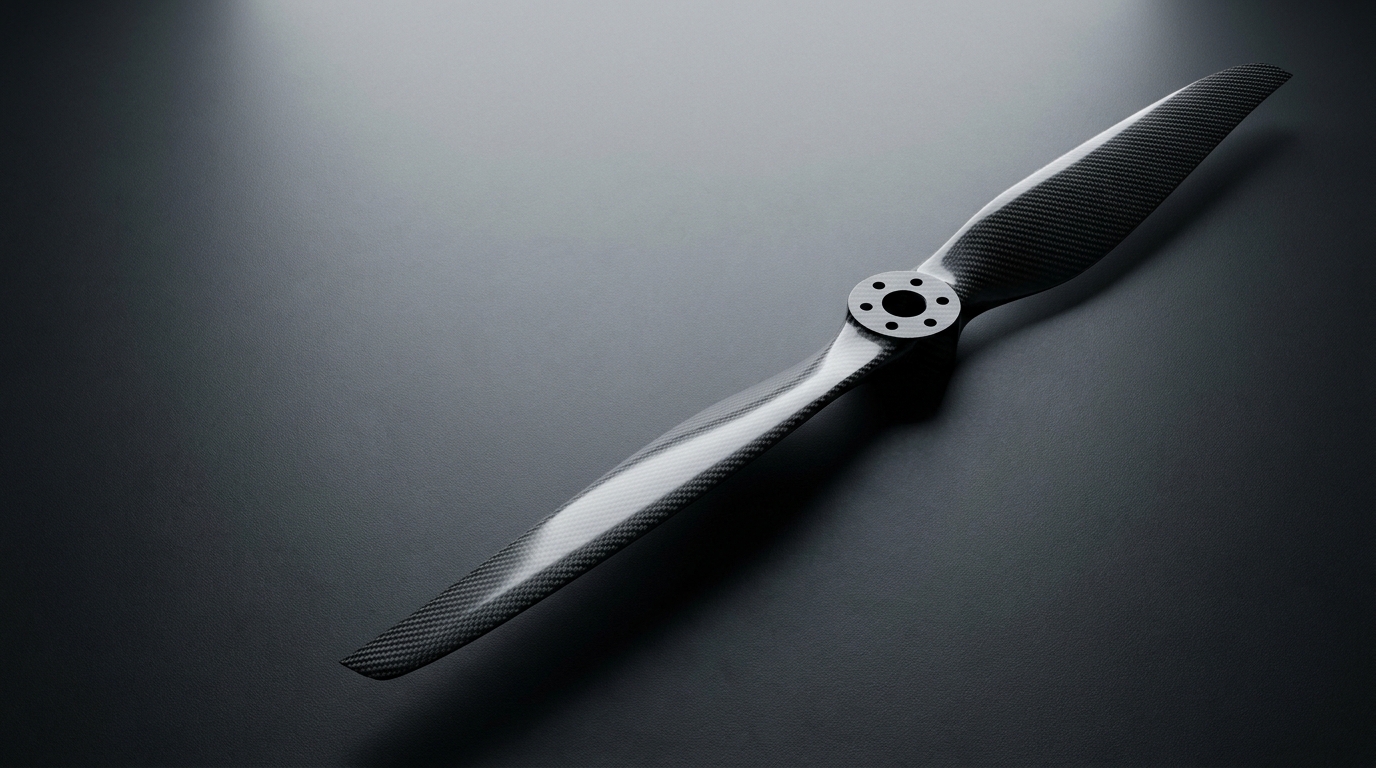
Why is propeller selection not just a matter of picking a size?
On a UAV project, the propeller is often chosen simply by looking at the diameter and pitch values in a catalog. This approach may be enough to get the first prototype spinning, but once the platform is flying its actual mission, outcomes such as efficiency, motor temperature, flight time, vibration, noise and structural reliability can turn out very different from expectations. That's because a propeller is not an accessory that operates independently of the motor — it is a thrust element that works together with the motor, the ESC, the battery, the airframe, flight speed and the control system.
The right choice starts not with 'how many inches of propeller can this motor turn?' but with 'what mission will the platform perform, at what speed, altitude and load condition?' A VTOL platform that needs high static thrust at takeoff and a fixed-wing UAV focused on long cruise endurance may not benefit from the same propeller geometry even if they share the same motor power.
What does diameter change?
As propeller diameter increases, the disk area swept by the blades grows. Redirecting a larger air mass with a lower increase in velocity can help produce thrust more efficiently under suitable conditions. On the other hand, as diameter grows, blade tip speed, moment of inertia, motor torque requirement and airframe clearance requirements also change.
Diameter selection must be made together with constraints such as the motor's torque characteristics, allowable RPM, ground clearance, spacing between propellers on multi-rotor platforms, folding mechanisms and storage volume. A larger diameter is not always better. A diameter that pushes the motor into a low-efficiency region or unnecessarily raises blade tip speed can turn a theoretical gain into a real-world loss.
Pitch and the real operating point
Pitch is one of the basic geometric parameters describing how far a propeller theoretically wants to advance in one revolution. However, a propeller doesn't advance through the air like a rigid screw without slip. During actual operation, slip, the local angle of attack along the blade, and the flow velocity distribution all come into play.
Low pitch generally tends toward easier spin-up at low speed and higher static thrust, while high pitch can offer an advantage at forward flight speed. But if the motor cannot supply enough torque, high pitch lowers RPM, increases current draw and can degrade overall system efficiency. For this reason, pitch must be chosen together with the target cruise speed and the motor's operating point.
Two, three, or more blades?
Increasing blade count allows more blade area to be achieved on platforms where diameter is limited. This is valuable in applications with tight airframe clearance, where propeller diameter cannot be increased, or where high thrust density is required. On the other hand, every additional blade affects the flow field of the others and increases profile drag.
Two-bladed propellers often offer low drag and high efficiency potential. Three or more blades can provide a compact diameter, smoother torque transfer, a different vibration character and packaging advantages. The decision should not be made simply on the logic that 'more blades produce more thrust.' Target thrust, diameter limit, RPM, noise and mechanical integration must all be evaluated together.
How does the mission profile determine propeller geometry?
Focusing on a single maximum thrust value when selecting a propeller can be misleading. If the UAV doesn't spend most of its mission at full throttle, what really matters is efficiency at the cruise or loiter operating point. For a platform that takes off heavily loaded but cruises for long periods at low power, a balance must be struck between the two different operating regions.
When preparing the mission profile, takeoff weight, payload, climb rate, cruise speed, endurance, loiter condition, target altitude, ambient temperature and possible wind conditions should be defined. In electric systems, the drop in battery voltage over the course of the mission also affects the propeller's operating point.
Why do material and stiffness matter as much as aerodynamics?
Even if the propeller geometry is correct in the design file, if the blade deforms under load the actual pitch and profile angle will differ from what was designed. For this reason, material selection is critical not only for strength but also for stiffness and deformation control.
In carbon fiber composites, fiber orientation allows the blade's bending and torsional behavior to be tuned to the needs of the project. Wood propellers can offer natural damping and prototyping advantages. Plastic or fiber-reinforced thermoplastic solutions can be suitable in terms of cost and impact behavior at high volumes. The right material should be chosen according to the mission and the production quantity.
Tulkas' approach: from operating point to a validated product
At Tulkas, the propeller development process begins with gathering customer requirements. Motor data, RPM range, target thrust, mission profile, diameter limit and environmental conditions are evaluated together. An existing geometry can be improved, or a design can be developed from scratch.
After the design phase, the production method and mold approach are determined; a prototype is produced, and depending on the scope of the project, thrust, torque, RPM, current, vibration, noise and structural behavior are monitored. The goal is not just to produce a sample, but to develop a propeller solution that can be revised based on test results and carried into repeatable production.
Frequently Asked Questions
What data should I share for a UAV propeller?
The motor model or torque-RPM data, battery voltage, target thrust, maximum diameter, mission profile, flight speed, rotation direction and, if available, the dimensions of an existing propeller form a sufficient starting data set.
Can the same propeller be used on different motors?
Even if it can be mechanically mounted, it may not deliver the same efficiency or safety. The motor's torque-RPM characteristics and allowable power limit must be re-evaluated.
Can selection be made based only on maximum thrust value?
No. Maximum thrust is an important limit, but cruise efficiency, current, temperature and noise behavior over most of the mission duration must also be taken into account.
Conclusion
Share your motor and mission data with the Tulkas engineering team so we can jointly determine the right propeller operating point for your platform.