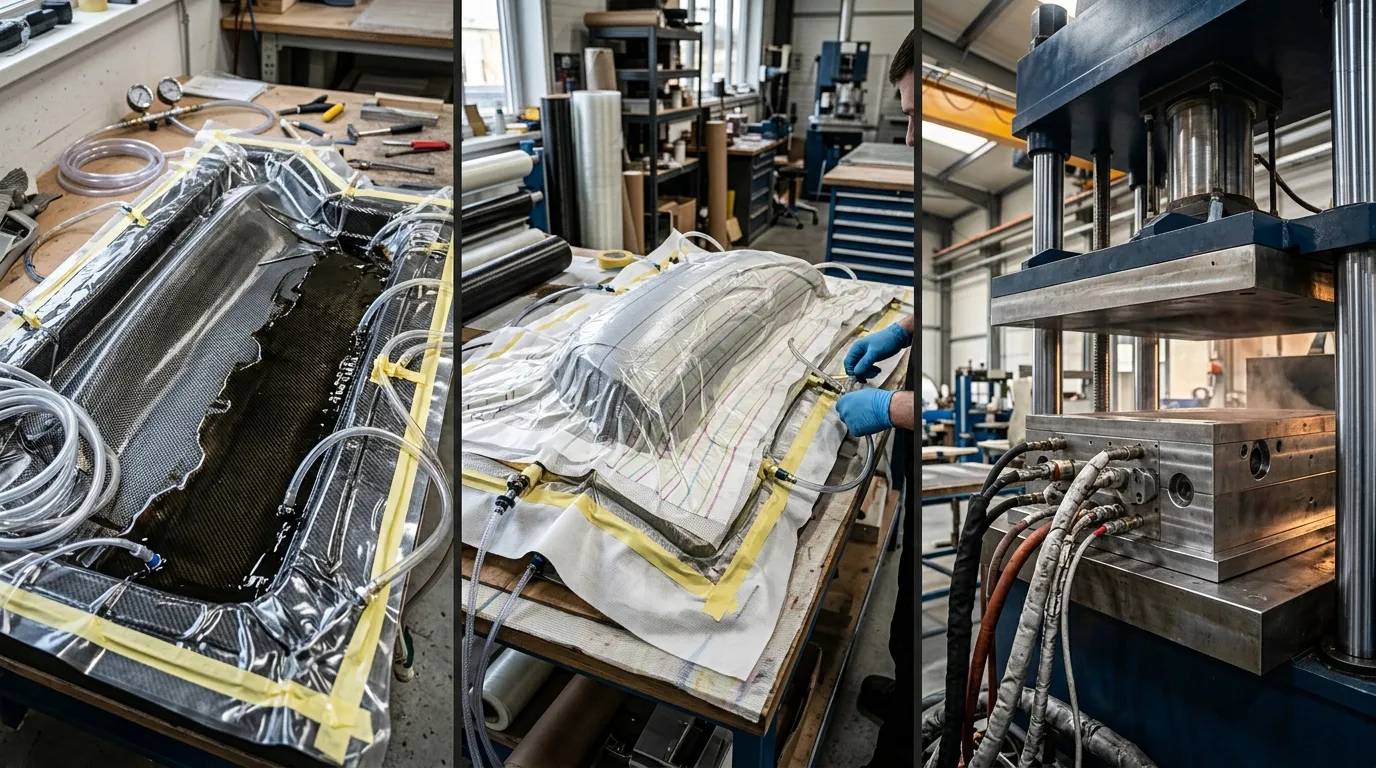
Method selection starts with the part definition
The method used to produce a composite part cannot be decided by looking at the material name alone. A carbon fiber cover, a thick mounting plate and a thin propeller can lead to different tooling and process needs. Part size, curvature, local thicknesses, surface expectation and production volume are the starting inputs.
It should also be decided which characteristics will be kept under control. A tolerance on a mating surface, a weight limit or the need for both faces to be tool-formed can change the method selection. A production setup that works for a prototype may need to be revisited for labor and cycle time as quantities grow.
In vacuum infusion, resin flow is planned
In vacuum infusion, dry reinforcements are placed in the mold and resin is drawn into the laminate by the pressure difference created under the bag. Fiber placement, resin inlets and vacuum outlets should be planned together. The aim is for the resin to reach every required area within a suitable time.
Resin viscosity, working time, temperature and the permeability of the reinforcement affect the flow. If the flow advances too quickly along some edges, it can reach the outlet before other areas are filled. That is why using a powerful pump is not enough. Bag integrity, flow media and resin consumption are also controlled.
In vacuum bagging, the consolidation setup matters
Vacuum bagging describes a broader group of processes. A wet laid-up laminate or a suitable prepreg system can be consolidated under a bag. Unlike infusion, the resin is usually applied to the reinforcement beforehand or is already contained in the material.
The role of the bag and consumables is to help remove air and achieve the designed consolidation. A bag that bridges across inside corners instead of seating on the surface can disrupt local pressure transfer. Release film, peel ply and breather layers are chosen according to the material system. Removing more resin than necessary is not a suitable production goal either.
In hot pressing, pressure and temperature are managed together
In hot press applications, material can be shaped and cured under heat and mechanical pressure within a suitable tool arrangement. Tool closure, material quantity, flow behavior and temperature distribution are decisive for the result. The details of the method depend on the material system and part geometry.
In suitable projects, advantages can be gained in control of both faces, thickness repeatability and cycle planning. On the other hand, tooling investment, press capacity and part access should be evaluated. Increasing pressure or temperature alone does not raise quality; fiber movement, resin loss and incomplete filling should also be controlled.
The comparison must use the same acceptance criteria
Rather than declaring one method superior to another, finished parts that perform the same function should be compared. Target weight, critical dimensions, surface quality, required tests and production quantity should be common. Looking only at first-article cost can overlook labor or tool maintenance in series production.
Curing, and post-curing where required, should be consistent with the resin manufacturer's data and the part requirements. Reaching a hardness at which the part can be demolded does not mean that all mechanical and thermal properties have been achieved. Dwell, heating, cooling and finishing operations should also be defined in the process plan.
How does Tulkas determine the production method?
Tulkas's active production methods include hot pressing, vacuum infusion and vacuum bagging. In the technical evaluation, the part's geometry, tolerance, surface, structural performance and volume expectations are examined together. The material and tooling approach is planned according to the needs of the chosen method.
Frequently Asked Questions
Are vacuum bagging and vacuum infusion the same process?
No. In infusion, resin is drawn into dry reinforcement by a pressure difference. Vacuum bagging can also be used to consolidate wet laid-up or suitably pre-impregnated material. Although infusion involves a vacuum bag, the two terms do not describe the same scope.
Does higher pressure always produce a better part?
No. The required pressure depends on the material system, geometry and process design. Uncontrolled pressure can disturb resin distribution or fiber placement. Quality is judged by producing the material within its validated processing window and under defined conditions.
Can the same part be made with a different method in prototype and in series?
Yes, but the effect of the changed process on the part's properties must be re-verified. Using the same CAD geometry does not guarantee an equivalent laminate, surface or mechanical behavior. A new first article and inspection plan are created when necessary.
Does Tulkas offer autoclave or RTM production?
Autoclave and RTM are not among the current active production methods listed on the Tulkas website. For projects that require these processes, the need and the possible solution scope should be clarified separately in the technical evaluation.
Let's define the right production route for your part
Share your CAD model, target quantity, critical dimensions and surface expectations with Tulkas. Let's evaluate material, tooling and production method together within the same technical scope.