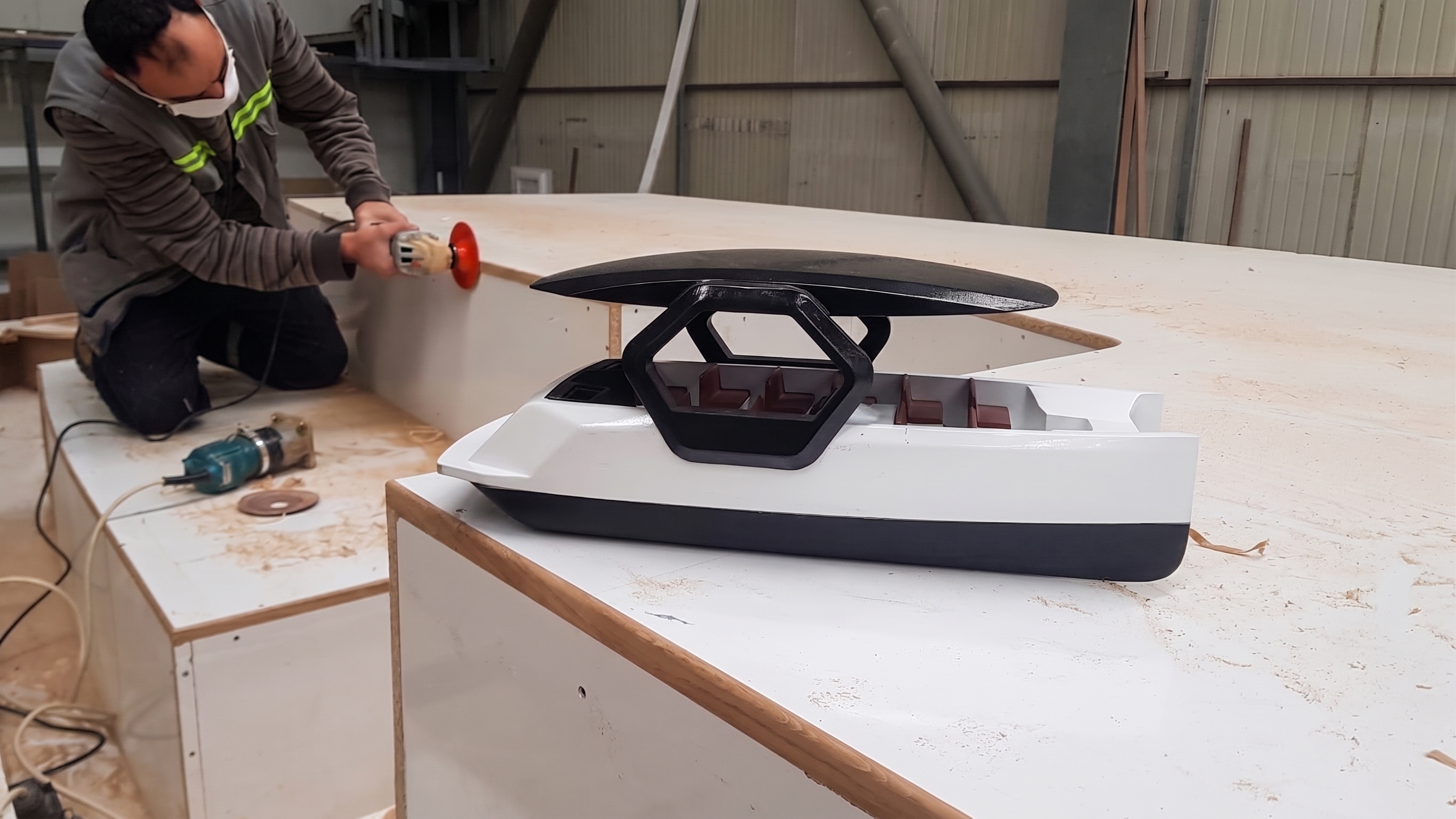
A working prototype doesn't mean series production is ready
In composite product development, getting the first sample out of the mold is an important milestone. But the fact that this sample fulfills its function doesn't prove that the same part can be produced dozens or hundreds of times with the same quality. In prototype production, skilled-worker intervention, manual correction, long cycle times and high tolerances can be acceptable. In series production, each of these creates cost and quality risk.
Moving to series production is not just about increasing quantity — it is about turning what was learned during the prototype phase into a process standard.
Defining requirements and acceptance criteria from the start
Deciding which dimension is critical after the part has already been produced is a step taken too late. Functional surfaces, connection regions, weight limits, surface expectations, mechanical tests and acceptance criteria should be defined at the design stage.
Holding every dimension to the same tolerance unnecessarily raises cost. The critical characteristics that actually affect performance should be identified, while production-friendly tolerances should be used elsewhere.
The difference between a prototype mold and a production mold
The role of a prototype mold is to enable fast, low-cost learning. Surface life, cycle count or automation may take a back seat. A production mold, on the other hand, is designed for dimensional stability, thermal cycling, ease of demolding, maintenance, operator ergonomics and repeatability.
One of the most common mistakes is trying to continue series production with the first prototype mold. The mold can wear out quickly, part dimensions can drift, or intensive manual labor may be required for every unit.
The ply plan and material standard
In a composite part, the material name alone is not enough. Fabric type, areal weight, fiber orientation, cutting geometry, splice locations, resin system, core, adhesive and inserts must be defined in the bill of materials.
If ply sequence and orientation are left to operator interpretation, stiffness and weight variation will appear between parts. Cutting templates, numbered ply books and visual work instructions strengthen repeatability.
Recording process parameters
Vacuum level, resin ratio, mixing time, ambient temperature, cure cycle, press pressure and demold time all affect product quality. In series production, checking only the final part is not enough — the process must be monitored too.
Process records make root-cause analysis possible when a defect occurs. They also provide data for comparing the effect of a customer revision or a material change.
First article approval and a pilot run
The first parts produced with the revised mold and process must be measured against series production acceptance criteria. Dimensions, weight, surface, connection fit and the mechanical tests within project scope are all verified.
Producing a small pilot run then reveals process variability that a single sample can't show. Part-to-part deviation, cycle time and operator dependency are evaluated at this stage.
Quality control and traceability
Lot records of input materials, production date, operator, mold number, process parameters, measurement results and revision level must be linked to the product. In mission-critical projects, serial numbers and test records become even more important.
Quality control is not just about picking out defects at final inspection. Incoming inspection, in-process control and final inspection are designed together, with the goal being to prevent defects from occurring rather than finding them afterward.
Tulkas' prototype-to-production working model
Tulkas treats technical requirements, design, analysis, mold, composite production, testing and revision as a single development cycle. Fast learning is the goal for low-volume prototypes; as the product matures, the mold, work instructions and control plan are developed to meet series production needs.
The goal is not just to deliver the part, but to build a sustainable production infrastructure supported by technical drawings, a routing card, a control plan, test results and revision history.
Frequently Asked Questions
Can a prototype mold be used for series production?
It can be used in some low-volume projects, but mold life, dimensional stability, cycle time and labor requirements must be validated against the series production target.
What is the most important document for series production?
No single document is sufficient. Technical drawings, the bill of materials, ply plan, work instructions, control plan and revision record all work together.
Why is a pilot run necessary?
A single sample doesn't show process variability. A pilot run reveals part-to-part deviation, cycle time and the effectiveness of the quality plan.
Conclusion
Share your existing CAD, sample and production target with Tulkas to turn your composite prototype into a repeatable product.