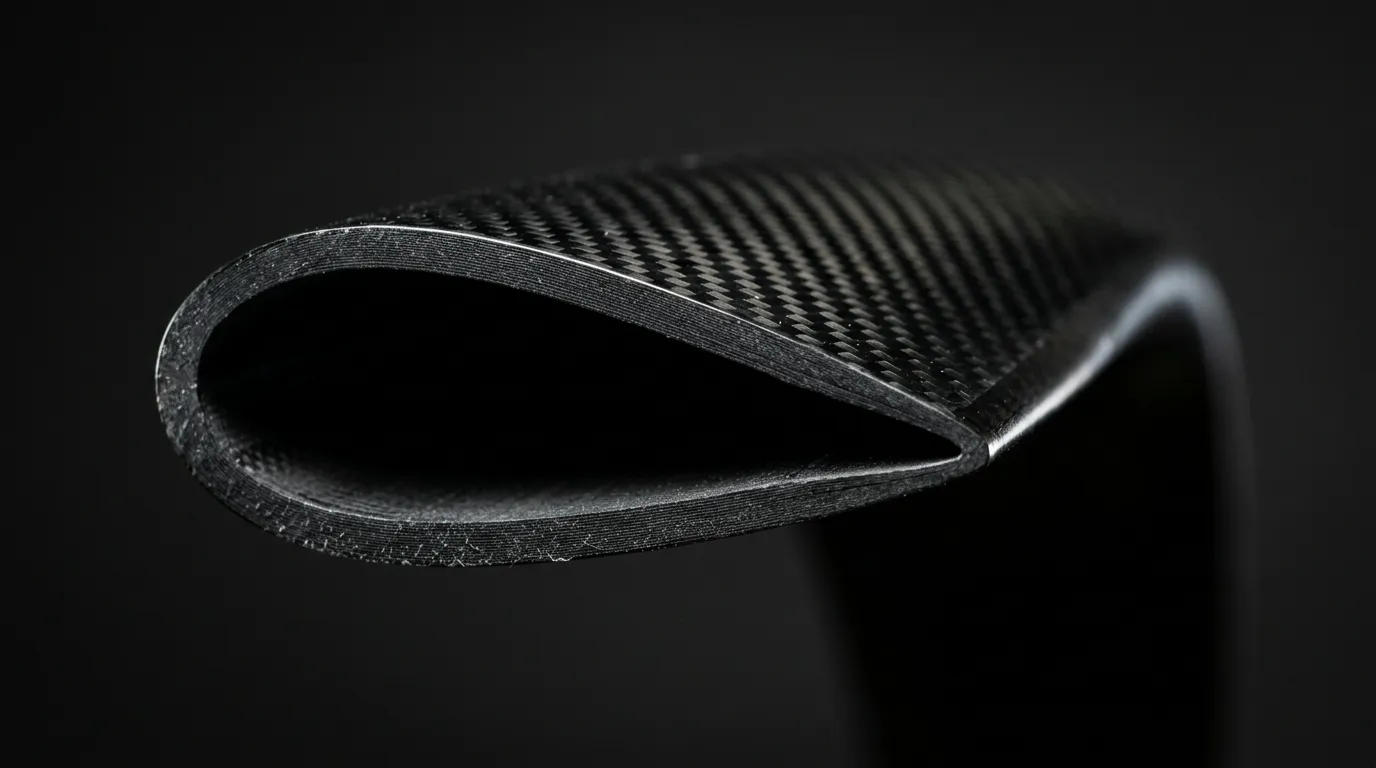
The hydrodynamic geometry must be realized in production
In foil design, the profile, span, chord and twist distribution are chosen for specific operating goals. How closely the produced part represents that geometry depends on mold accuracy, lamination layout and finishing operations. A correct CAD file does not on its own show that the final part has the same surface.
Before going into production, it should be decided which sections, edges and mating surfaces are critical. It should also be stated against which datums the dimensions will be evaluated. Even if the wing shape is correct, an angular deviation at the mounting surface can make the part work at a different angle in the system.
Profile accuracy and surface gloss are different things
A glossy surface is not on its own a measure of roughness or profile accuracy. Waviness, mold joint marks, local dips and thickness variations may not be easy to see. Surface quality should be evaluated with measurements suited to the design requirement, not just by appearance.
Leading and trailing edges are sensitive areas during production and handling. The shape, strength and finishing method of these areas are planned together. Thinning the trailing edge as much as possible or sanding the part at random is not a correct way to improve it. Any finishing operation should preserve the target geometry and the load-carrying plies.
Tooling and curing affect geometric repeatability
Distortion of the mold during processing or deviations in its closure can affect the final profile. Laminate placement, resin distribution and curing conditions also play a role. For the surface achieved on the first article to be preserved on later parts, the production definition must be repeatable.
In a structure formed from two half-shells, the joint line and the bonding operation are also evaluated. Internal connections in closed structures can become inaccessible after production. That is why the assembly sequence, adhesive control and any necessary in-process checks should be considered together with the mold design.
Stiffness can affect the operating angle
When a foil bends and twists under load, its operating geometry changes. The behavior of the wing and the mast should be evaluated together. Stiffening only the wing does not eliminate movement coming from the connection or the mast. What matters is the total change of shape under real loads.
The fiber orientations and section layout of the carbon laminate are chosen according to bending and twisting targets. The goal is not maximum stiffness everywhere, but a structure balanced with weight, load transfer, strength and manufacturability. Especially on long, narrow wings, a change in geometry can move the foil away from the operating condition the design anticipated.
Connections and maintenance matter as much as the surface
Play, angle repeatability and assembly force at the wing–mast and other interfaces should be controlled. Clean, undamaged mating surfaces help the part sit in the same position at every assembly. In marine applications using metal fittings, galvanic compatibility and sealing are also evaluated.
Edge damage, a deep scratch or a crack around a connection should not be treated as merely cosmetic. The repair decision should be made according to the extent of the damage. Uncontrolled sanding by the user can change the profile and the protective surface. The maintenance approach should be consistent with the part's technical definition and operating conditions.
The complementary roles of Tulkas and Navarc
Tulkas focuses on material, tooling, production and interface requirements for composite components such as foils, masts and struts. Boat design, hydrodynamic analysis, hydrofoil system architecture and active control are within the scope of its group company Navarc. Carrying the load and geometry requirements from the system correctly into production is the key link between the two areas of expertise.
Frequently Asked Questions
Does a glossy foil surface guarantee lower drag?
No. Gloss is an optical property; on its own it does not give enough information about profile accuracy, waviness or roughness. Performance should be evaluated against operating conditions and defined surface requirements.
Is a stiffer mast better for every use?
Stiffness affects the operating geometry, but it should be evaluated together with weight, connections and other structural requirements. The mast's bending and torsional behavior can also differ. A single stiffness claim does not describe every characteristic in use.
Can minor surface damage be fixed by sanding?
A general repair recommendation should not be given without knowing the depth and location of the damage. Sanding can change the profile or the load-carrying plies. The appropriate assessment and repair method should be clarified with the part manufacturer.
Does Tulkas design complete hydrofoil boat systems?
Tulkas focuses on the design and production engineering of composite foils, struts and structural components. Boat-level design, hydrodynamics, active control and system integration are handled by Navarc.
Let's evaluate your foil component against production requirements
Share the geometry, load cases, critical profile tolerances and connections with Tulkas. Let's define the composite structure and production plan together according to the needs of your system.