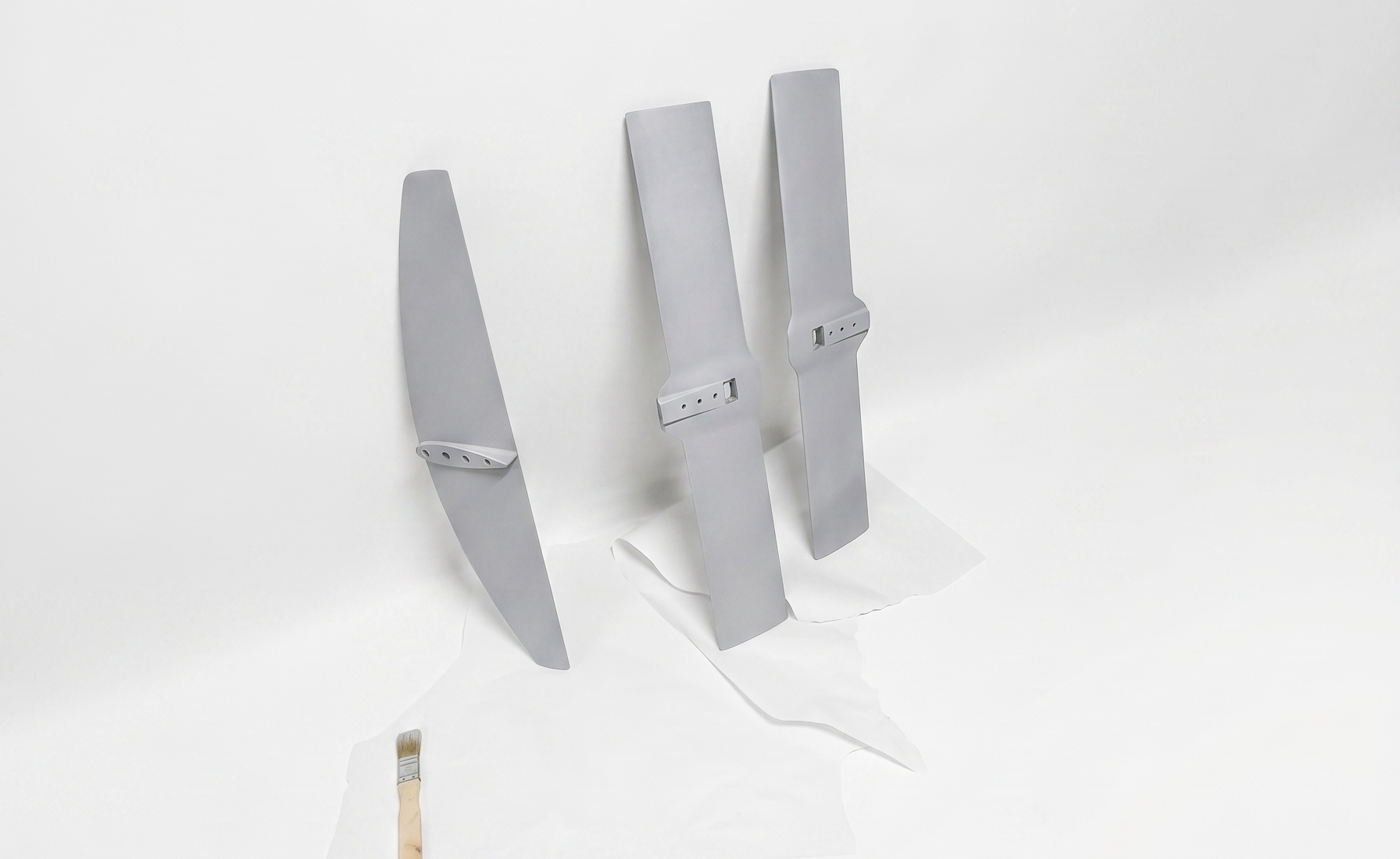
For hydrofoil boat design, active control and platform integration, get in touch with Navarc Mühendislik; for carbon fiber foils, struts and special composite components, get in touch with Tulkas.
What does a hydrofoil do?
A hydrofoil uses the lift generated by wings operating underwater to raise a portion or all of the hull above the water's surface. When the hull's wetted area and wave-making resistance are reduced, the propulsion power needed, especially at high speed, can drop significantly. The right geometry and control approach can also reduce the vertical impacts and pitching motion that waves transmit to passengers.
Tulkas' group company Navarc Mühendislik (https://navarc.com.tr/) treats hydrofoil technology not just as a wing added under the boat, but as an integrated marine vessel system in which the hull, front and rear foils, struts, propulsion system, sensors, actuators and control software all work together.
Why isn't a hydrofoil just a single wing?
A single foil can generate sufficient lift, but that alone doesn't mean safe and stable flight. The relationship between lift and the boat's center of gravity, the load-sharing between the front and rear foils, the moment effect of the propulsion line, passenger and battery placement, wave conditions and the response speed of the control surfaces must all be evaluated together.
A real hydrofoil project requires the joint work of naval architecture and hull hydrodynamics, foil-strut hydrodynamics, structural and composite design, and sensor-actuator-control algorithm disciplines.
While Navarc Mühendislik brings these disciplines together at the boat level, Tulkas focuses on the composite material, mold and manufacturing engineering of the foil, strut, connections and other special parts. The two companies operate under the same group, with complementary areas of expertise.
How is lift generated?
As the foil section moves through the water, a pressure difference forms between the lower and upper surfaces. This difference produces lift depending on water density, speed, wing area, profile geometry and angle of attack. As speed increases, lift at the same area and angle of attack grows roughly with the square of the speed.
This is why a hydrofoil boat travels on its hull at low speed. At a certain takeoff speed, the foils begin producing enough lift to carry the boat's weight and the hull rises out of the water. As speed changes, the foil angle, flap position or load sharing must be readjusted to maintain the same height.
In Navarc's system approach, not just a single design speed but the entire operating envelope — takeoff, cruise, turning, wave passage, different loading conditions and safe landing conditions — is evaluated.
Why is front-rear foil balance critical?
In a boat in full foilborne flight, lift is generally shared between the front and rear foil systems. This sharing is needed not only to carry the total weight but also to balance the boat's pitching moment.
A small angle change on the front foil can raise or lower the bow. The rear foil, the position of the propulsion system and the direction of thrust also affect this balance. Passengers shifting position, battery level, different loads or wave impacts can instantly change the center of gravity and moment balance.
In Navarc Mühendislik's actively controlled hydrofoil approach, sensor data is used to monitor the boat's height, roll angle and pitching motion. When necessary, the control system adjusts foil or flap commands to keep the boat in the targeted flight condition.
Wing area and aspect ratio balance
A larger wing area can make takeoff easier at low speed, but it increases wetted area and profile drag. A small foil area can be advantageous at high speed but can raise the takeoff speed and make low-speed control harder.
Long, narrow wings — that is, high aspect ratio — have the potential to reduce induced drag. On the other hand, as the span grows, bending moment, impact risk, docking difficulty and structural requirements all increase. This is why Navarc's boat-level optimization jointly considers efficiency, strength, water depth, port operations, transport and real route conditions.
Why is the mast/strut as important as the wing itself?
The mast or strut transfers foil forces to the hull and operates while piercing the water surface. A thin section reduces drag, but it must safely carry the high bending and torsional moments that arise under wave, maneuvering, asymmetric-lift and impact conditions.
Strut thickness, profile shape, hull and foil connections, surface quality and the tendency to draw air from the surface all directly affect system performance. Excessive flexing of these parts not only creates structural problems — by changing the foil's angle of attack it can also disrupt the hydrodynamic behavior expected by the control system.
This is where Tulkas' composite expertise comes in. Fiber orientation, local reinforcements, metal inserts, mold accuracy and surface quality are turned into a manufacturable part based on the hydrodynamic and structural requirements set by Navarc.
The difference between cavitation and ventilation
Cavitation is the formation of vapor bubbles when local pressure drops below the vapor pressure of water. The collapse of these bubbles in a high-pressure region can cause noise, vibration, surface erosion and performance loss.
Ventilation, on the other hand, is air being drawn into the region around the foil from the free water surface or an air pocket. Wings operating close to the surface, strut-foil junctions, wave crests and hard maneuvers can increase the risk of ventilation. Although the two phenomena can produce similar lift loss, their physical causes and solutions differ.
In Navarc's hydrofoil development process, profile, operating depth, speed, load and maneuvering conditions are evaluated together. On Tulkas' side, accurately transferring the geometry to the mold and preserving the hydrodynamic surface throughout production are considered critical.
Passive and active stability
Passive hydrofoil systems can achieve a degree of self-stabilization through wing geometry, surface-piercing foils or mechanical linkages. These solutions can be simpler, but their control capability can be limited as the range of speed, load and wave conditions widens.
In active systems, height, acceleration, angular rate and boat attitude are monitored with sensors. The control algorithm manages flaps, foil angles or appropriate actuators in real time. This way, a wider and more comfortable operating range can be targeted across different speeds and sea conditions.
Navarc Mühendislik's hydrofoil work treats active control not as a software add-on separate from the mechanical system, but as part of the boat's hydrodynamic and structural design from the outset. Sensor failure, actuator limits, power loss and safe water-landing scenarios must also be considered in the system architecture.
The composite structure advantage in hydrofoils
Achieving high stiffness with a thin hydrodynamic section is required for foils and struts. Carbon fiber composites allow fiber orientation to be placed according to real load paths, achieving high bending-torsion stiffness with low weight.
However, using carbon fiber alone is not enough to produce a good hydrofoil part. The laminate must be validated for bending, torsion, shear, impact, fatigue, connection holes, metal inserts, galvanic isolation and water ingress. Profile tolerance and surface smoothness are also important for preserving hydrodynamic performance.
Tulkas translates the system requirements of its group company Navarc Mühendislik into composite part design, mold, prototype and production process. In this way, Navarc's goals at the boat and control-system level meet Tulkas' manufacturability and material approach within the same development cycle.
Navarc Mühendislik's boat-level hydrofoil approach
Hydrofoil performance is not determined by the foil's open-water lift and drag values alone. Pre-takeoff hull resistance, foil-hull interaction, propulsion system flow, center of gravity, trim, wave direction and control system response all change real performance.
Navarc Mühendislik treats naval architecture, hydrodynamic analysis, electric boat development, propulsion integration and active hydrofoil control as a single platform problem. Design decisions are developed using data from numerical analysis, engineering calculations, prototype production and water testing.
The goal of this approach is not just to lift the boat out of the water. The target is an integrated marine vessel that can transition from takeoff to cruise, maintain moment balance under different loads, respond in a controlled way to waves and maneuvers, and behave safely in case of a fault.
For more information about Navarc Mühendislik and hydrofoil work, you can visit navarc.com.tr (https://navarc.com.tr/).
How do Tulkas and Navarc work together on the same project?
Tulkas and Navarc Mühendislik operate under the same group, with different but complementary areas of expertise:
- Navarc Mühendislik: Boat concept, hull hydrodynamics, foil placement, front-rear load sharing, moment balance, propulsion integration, active control architecture and sea trials.
- Tulkas Mühendislik: Laminate design, mold development, prototype production, surface quality and series-production readiness for carbon fiber foils, struts, connecting elements and special composite parts.
This division of responsibility prevents the hydrofoil system from being treated as a single line-item supply. While boat, control and hydrodynamic decisions are managed by Navarc, high-precision composite components are realized through Tulkas' manufacturing engineering.
Frequently Asked Questions
Should I contact Tulkas or Navarc for a hydrofoil project?
If a new hydrofoil boat, an active control system, or foil integration on an existing boat is being developed, the main system discussion should be with Navarc Mühendislik. Tulkas is engaged for carbon fiber foils, struts or project-specific composite part production. Thanks to the group structure, the two needs can be coordinated between the same technical teams.
Why does a hydrofoil boat travel on its hull at low speed?
Lift increases with speed. Before the foils generate sufficient lift, the boat moves supported by its normal hull. Takeoff speed depends on total weight, foil area, profile, angle of attack and control strategy.
Does a larger foil always mean an earlier takeoff?
Increasing area generally raises low-speed lift, but drag, structural load, maneuvering behavior and high-speed performance also change. That's why Navarc Mühendislik sizes foil area not in isolation but within the entire mission envelope.
Is an active control system mandatory?
It is not mandatory for every hydrofoil application. But if a constant flight height and comfort are targeted across different loads, speeds and wave conditions, active control can provide a significant advantage. The system must be developed together with the mechanical design, sensors and safety scenarios.
Conclusion
A hydrofoil is not an independent wing bolted under the boat — it is an integrated system in which hydrodynamics, structure, propulsion and control disciplines work together. Tulkas and its group company Navarc Mühendislik bring these different areas of expertise together under one structure.
Plan a technical discussion with Navarc Mühendislik (https://navarc.com.tr/) for hydrofoil boat design, active control and platform integration, and with Tulkas for carbon fiber foils, struts and special composite components.