Why do similar-looking parts have different prices?
Two parts with the same outer geometry can be produced for different functions. One may be a cosmetic cover, the other a component carrying load under vibration. For the second, the ply structure, material records, critical tolerances and test requirements differ. That is why comparing quotes using only a photo and outer dimensions can be misleading.
For a comparison, the technical scope must be equalized. The material definition, weight target, surface, assembly features, documents to be delivered and quantity should be the same. It should also be explained which development and verification work the price includes. A lower quote is sometimes the price of a different part or of an incomplete scope.
Material cost is larger than the net part weight
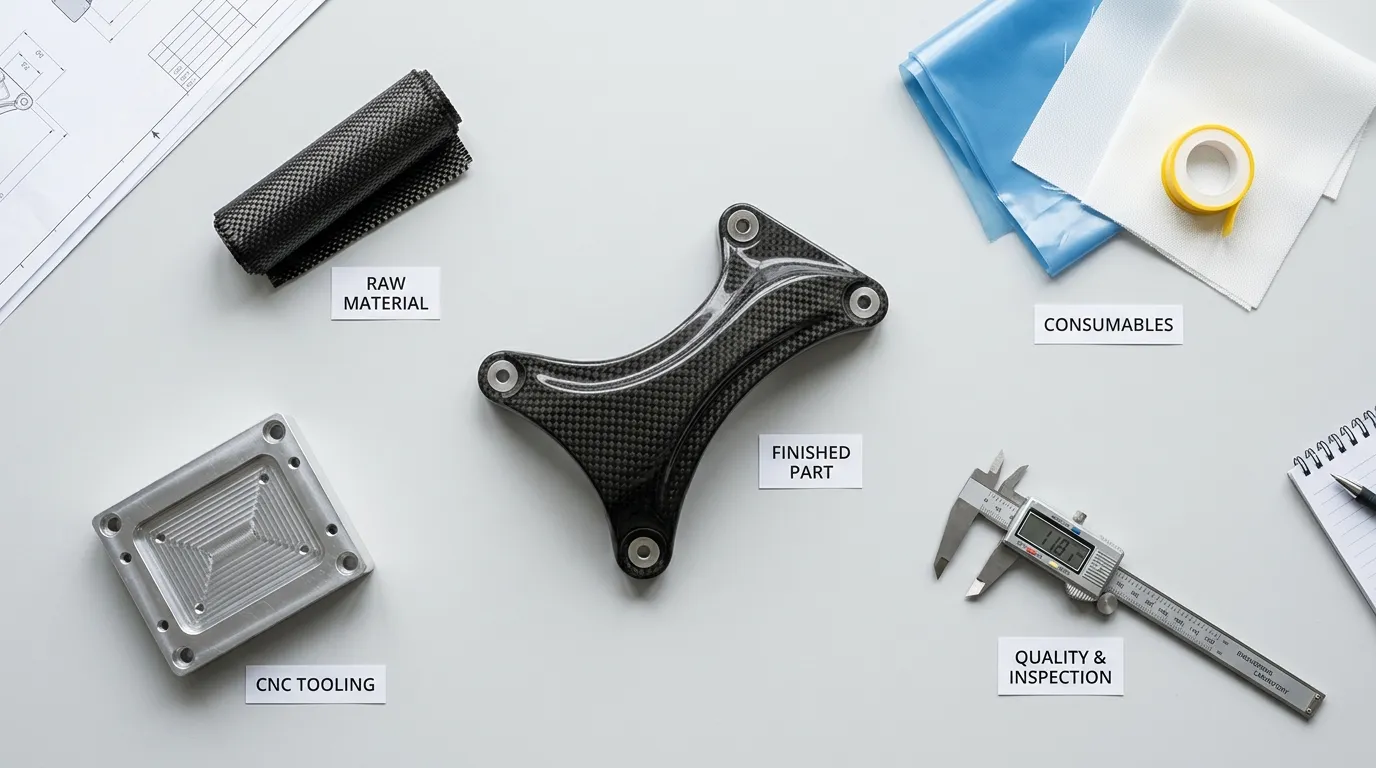
The weight of the finished part does not show the total material purchased for production. Fabric cutting waste, areas extending beyond the mold, resin consumption and production consumables add to the cost. Vacuum film, peel ply, flow media and release agents are also counted in the relevant processes.
Waste can be reduced by improving the cutting layout, but fiber orientations that must be preserved on the part should not be changed. Frequent design revisions, sourcing special materials in small quantities or storage conditions can also affect cost. The right material choice relates as much to supply and production planning as to performance.
Tooling and development costs are affected differently by quantity
Design, tooling and first-article work are costs incurred at the start. How they are spread per part depends on the production quantity. For example, purely for illustration, if an initial cost of TRY 60,000 is assumed, spreading it over 20 parts gives TRY 3,000 per part and over 200 parts TRY 300 per part. These figures are not Tulkas prices and do not include material, labor or other costs.
However, this simple distribution does not mean that every mold can produce an unlimited number of parts. As quantities rise, additional molds, maintenance, fixtures or process investment may be required. That is why costs for prototype, pilot series and regular production should be evaluated separately.
Labor and cycle time are decisive
The number of plies, small details, insert placement and hard-to-reach areas can increase production time. Preparation and cleaning operations are also important in multi-piece molds. A small detail in a CAD design can require extra work on every part in production.
Time spent curing and the operator's active working time are not the same cost item. Even so, a mold or piece of equipment being occupied for a long time affects production capacity. The cycle plan also determines how many parts can be delivered in which time frame. Focusing only on reducing manual labor can overlook a significant part of the total time.
Finishing and verification are part of the quote
Edge trimming, holes, surface rework, coating and assembly operations all generate cost. Requiring very tight tolerances or a flawless cosmetic finish on every surface can increase labor without contributing to the part's function. Identifying which areas are truly critical gives a more balanced quote.
Dimensional reports, balancing, load testing or special inspection requirements should also be defined from the start. Making a part cheaper by removing inspection and eliminating unnecessary inspection are different decisions. The verification the design needs should be kept, and the reporting scope should match real use and customer expectations.
Manage cost at the design stage with Tulkas
Tulkas approaches quotation work by evaluating geometry, material, tooling, quantity and quality expectations together. Simplifying non-critical dimensions, reducing the number of parts or adopting production-friendly details can bring cost improvements. The goal is to determine the total cost of a solution that preserves function and can be produced repeatedly.
Frequently Asked Questions
Why doesn't the price fall at the same rate as quantity rises?
The share of initial costs can decrease, but material and per-part labor do not disappear. Capacity, additional tooling and inspection requirements can also change. The unit price is calculated from the whole production scenario.
Should the tooling cost be separate from the part price?
Either commercial model can be used; what matters is that the scope is clear. Tool ownership, maintenance, storage, revisions and the terms for repeat orders should be clarified. Quotes can then be compared against the same total need.
Is using glass fiber instead of carbon an adequate way to save money?
The material cost may change, but a different thickness and weight may be needed for the same stiffness. Labor and tooling costs also remain. Alternatives should be evaluated on finished parts that meet the same function and acceptance criteria.
What information is needed for the most accurate quote?
A CAD model or drawing, the operating environment, critical characteristics, prototype quantity and estimated series volume are the key inputs. Test, documentation and surface expectations should also be stated. Missing information can lead to prices based on assumptions that change later.
Get a quote by clarifying the technical scope
Share your part model, intended use and production plan with Tulkas. Let's evaluate development, tooling and part production costs together on the basis of a clear scope.