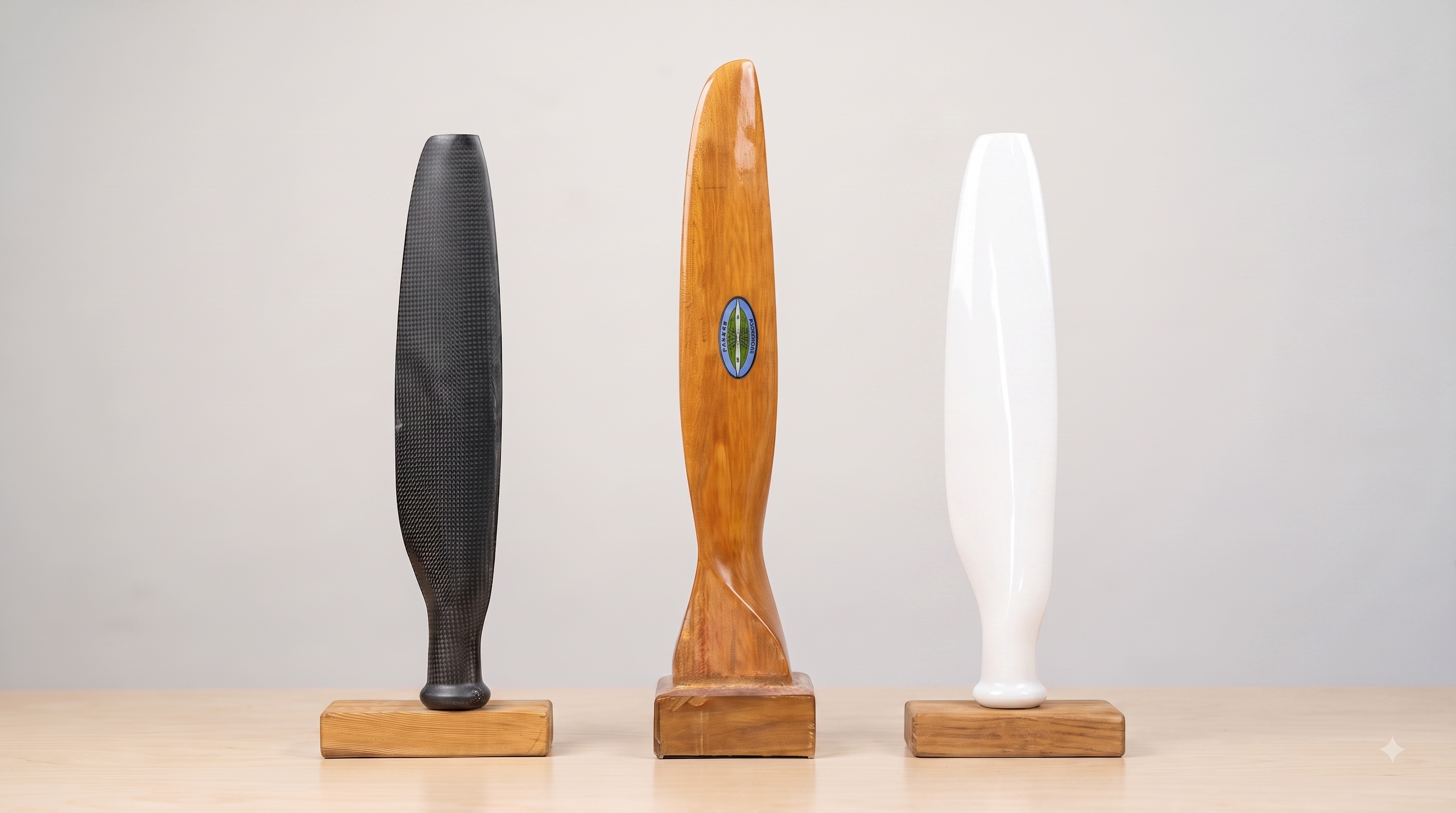
There is no single 'best propeller material'
A common mistake when choosing a propeller material is assuming that the material with the highest mechanical properties will give the best result under every condition. In reality, a propeller's success is not measured by tensile strength alone. Stiffness, density, fatigue behavior, impact tolerance, moisture and temperature effects, production repeatability, surface quality, balance and target quantity must all be evaluated together.
Carbon fiber, wood and plastic propellers can each have different advantages even within the same platform class. The right decision depends on whether a prototype or a production product is being developed, on flight reliability, cost limits and performance targets.
Carbon fiber propellers: high stiffness and low mass
Carbon fiber composites, thanks to their high specific stiffness, help limit unwanted deformation of the blade under load. Preserving the geometry during operation is a significant advantage, especially on platforms requiring high RPM or precise control. Low rotating mass can help the motor respond faster to speed changes and allow the control system to operate more nimbly.
That said, a carbon fiber propeller is not just a part with a visible carbon weave on the surface. Fiber orientation, ply layup, root reinforcement, resin system, cure and balancing process all determine performance. A poorly designed carbon propeller, or one with weak process control, cannot deliver the material's theoretical superiority in the field.
Wood propellers: prototyping, damping and balanced cost
When processed with the right species, correct grain direction, moisture control and protective coating, wood is a highly functional engineering material for propeller production. Its natural internal damping can help manage vibration. CNC machining or controlled molding methods allow prototype geometries to be tried out relatively quickly.
Wood propellers can offer a good cost-performance balance for low- and medium-volume production, design validation work, and certain aircraft classes. However, moisture, coating integrity, grain defects and production repeatability must be carefully managed. Not every type of wood and every layup structure gives the same result.
Plastic and fiber-reinforced plastic propellers
Injection-molded plastic propellers offer low unit cost and fast production at high volumes. Their ability to behave more ductile than carbon composite under impact can be useful on platforms with a risk of small, frequent collisions. High geometric repeatability once the mold investment is complete is also an important advantage.
On the other hand, plastics have a lower modulus of elasticity. The blade can twist under load and temperature, and the actual pitch can change. Carbon or glass fiber reinforcement can increase stiffness, but material flow direction, moisture absorption, temperature and mold parameters affect the outcome. At very high performance targets, the design must be evaluated together with deformation.
Decision criteria: performance, volume and risk
If high stiffness, low weight and precise geometry retention are the priority, carbon fiber is a strong candidate. If fast prototyping, low-to-medium volume and natural damping matter, wood can offer an advantage. If high volume, cost and impact tolerance are the priority, fiber-reinforced plastic solutions can be considered.
This decision should not be made on unit price alone. Mold cost, testing needs, scrap risk, balancing time, service life, post-damage behavior and supply continuity are all part of the total cost. Sometimes a material that appears more expensive can be more economical over the life cycle by reducing platform energy consumption or maintenance needs.
Why are hybrid structures used?
In some projects, a hybrid structure is more appropriate than a single material. Carbon fiber's stiffness can be combined with glass fiber's impact and cost advantage, or with the formability of a wood core. Metal inserts can be used for the root connection and load transfer.
The success of a hybrid design depends on managing the stiffness mismatch between different materials and the interface stresses. Simply stacking materials on top of each other is not enough — the load path, bonding surface, environmental conditions and manufacturing sequence must be designed together.
How does Tulkas approach material selection?
Tulkas does not consider material selection separately from geometry and production method in propeller projects. The mission profile, target RPM, thrust, diameter, quantity, cost and test plan are examined. If needed, carbon fiber, wood, plastic or hybrid alternatives are compared against the same performance target.
In the end, the goal is not 'to use carbon' but to develop a propeller that is sufficiently light, stiff, durable, manufacturable and repeatable for the platform. The real value of a material comes from correct design and controlled process.
Frequently Asked Questions
Is a carbon fiber propeller always more efficient?
No. Stiffness and low weight can provide an advantage, but aerodynamic geometry, surface quality, operating point and motor matching together determine efficiency.
Can wood propellers be used on defense or professional platforms?
They can be used if mission requirements, environmental conditions and the validation plan allow it. Material selection should be based on technical requirements rather than platform class.
Why does a plastic propeller deform under high load?
Plastics have lower stiffness than carbon composites. The blade can flex and twist under load and temperature, which changes the actual operating geometry.
Conclusion
To make the material decision based on mission and production data rather than catalog habit, open your project to technical evaluation with Tulkas.