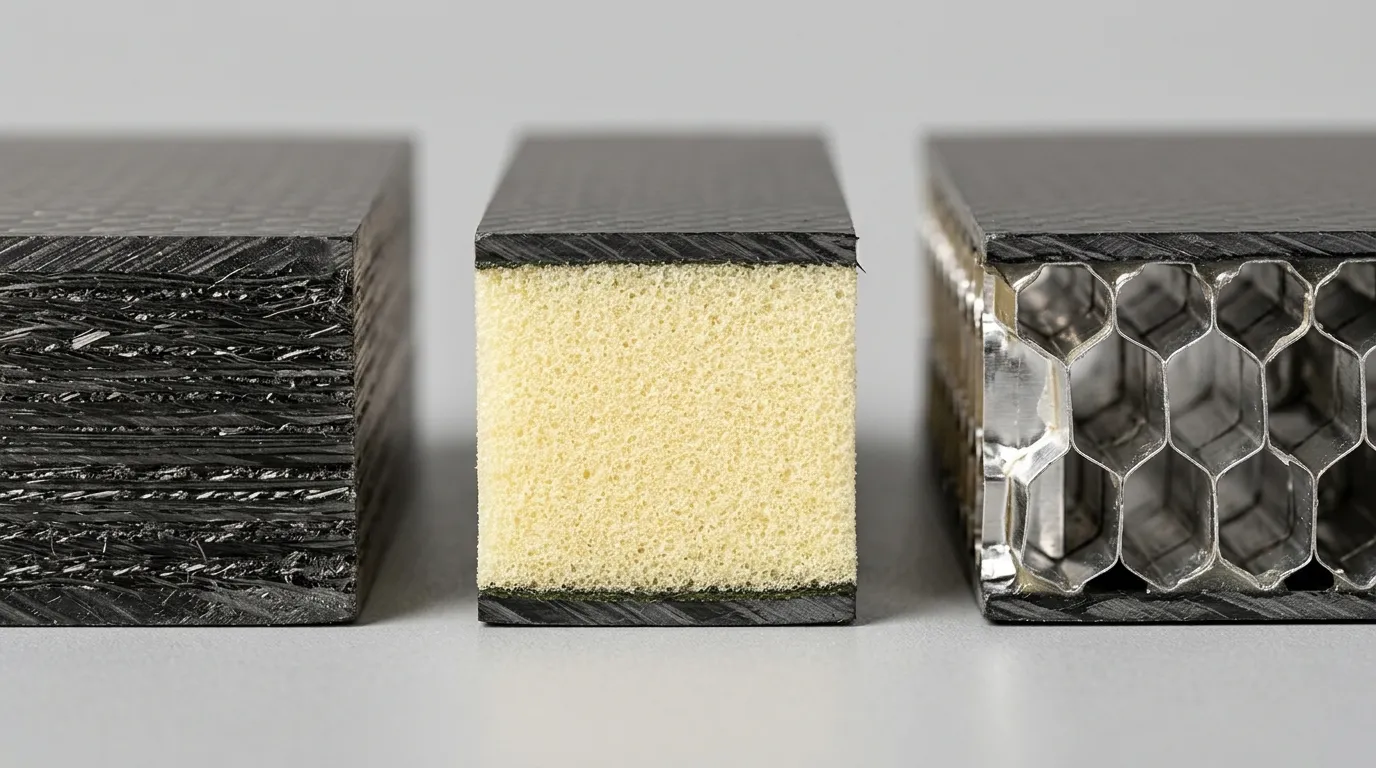
What need does a sandwich structure answer?
Filling the entire section with dense material is not always an efficient way to limit the bending of a large panel. In a sandwich structure, two load-carrying skins are separated by a lightweight core. When designed properly, this section layout can provide high bending stiffness at low mass.
The skins carry the tension and compression loads that arise in bending, while the core makes the skins work together and transfers shear loads. The bond between them is a fundamental part of the structure. It is not correct to treat the core as a material that merely fills a gap; crushing, shear and skin-to-core debonding should also be examined.
When is a foam core considered?
Structural foams are available with different densities, temperature resistance and mechanical properties. Besides density, shear and compression behavior, compatibility with the resin and curing conditions should be taken into account. Different foam types of the same density may not be direct alternatives to one another.
On curved surfaces, shaping, scoring or grooving the core affects production. Some core treatments can increase resin uptake. A core that looks light on paper can push the panel over its target weight if it carries more resin than expected in production. That is why final panel mass should not be estimated from dry material data alone.
Cell structure matters in a honeycomb core
Honeycomb cores can deliver effective structural performance at low weight in the right applications. However, the honeycomb material, cell size, density and orientation are evaluated together. It should not be assumed that the core shows the same shear behavior in different in-plane directions.
Compatibility of the open-cell structure with the manufacturing method is also important. Resin control, adhesive selection, unintended cell filling and moisture ingress at the edges affect the design. An infusion setup created for a foam core cannot be applied in the same way to every honeycomb core. Material and process should be chosen together.
Where does a solid laminate make sense?
A solid laminate may be suitable in narrow sections, thin geometries or areas where the load is concentrated in a small region. There is no requirement to build an entire panel from a single structure type. Sandwich can be used over large areas, with solid or high-density local zones around connections.
These transitions should not be abrupt. Stress concentrations can form where stiffness and thickness change quickly. Local reinforcement should be arranged to transfer the load into the neighboring structure. The advantage of choosing a sandwich should be evaluated after the connection and edge details are taken into account.
Connection and edge details must be part of the design
When bolt clamping force is transmitted directly to a weak core, crushing can occur. Inserts, potting or load-spreading reinforcements should carry the connection load into a suitable area. The locations of these details should be defined before holes are drilled and before the panel goes into production.
Cut edges, hatch perimeters and pass-through holes can be entry points for environmental effects. The edge sealing method and finishing operations are chosen according to the operating environment. Since core damage or skin-to-core debonding can exist even when the skins look sound, the inspection approach should also suit the structure type.
Defining the panel structure with Tulkas
Tulkas approaches UAV airframe components from the standpoint of material, geometry and manufacturability together. The need for a solid or sandwich structure is evaluated through loads, connections, the weight target and production conditions. Project-specific core and verification requirements are clarified when the technical scope is defined.
Frequently Asked Questions
Is a honeycomb core always lighter than foam?
The density of the core itself is not a sufficient basis for comparison. Adhesive, edge closures, local potting and skins also add to the total mass. The comparison should be made between finished panels that meet the same load and stiffness requirements.
Can a bolt be fitted anywhere on a sandwich panel?
If the connection area is not designed for that load, direct bolting can crush the core or damage the skins. The need for inserts and local reinforcement should be determined with the clamping force and service loads in mind.
Does a thicker core always give a better result?
Core thickness can contribute to bending stiffness, but shear, local crushing, connection and overall size requirements also change. The design cannot be completed simply by increasing thickness. All failure modes should be evaluated together.
Can damage to a sandwich panel be seen from the outside?
Not all damage is visible. Skin-to-core debonding or core crushing may leave only limited external marks. The inspection method is chosen according to the part's structure and its importance to the mission; a surface photo alone is not a sufficient assessment.
Share your airframe and panel requirements
Share panel dimensions, loading conditions, connection points and target weight with Tulkas. Let's evaluate material options together for a manufacturable structure and a suitable verification approach.