2020
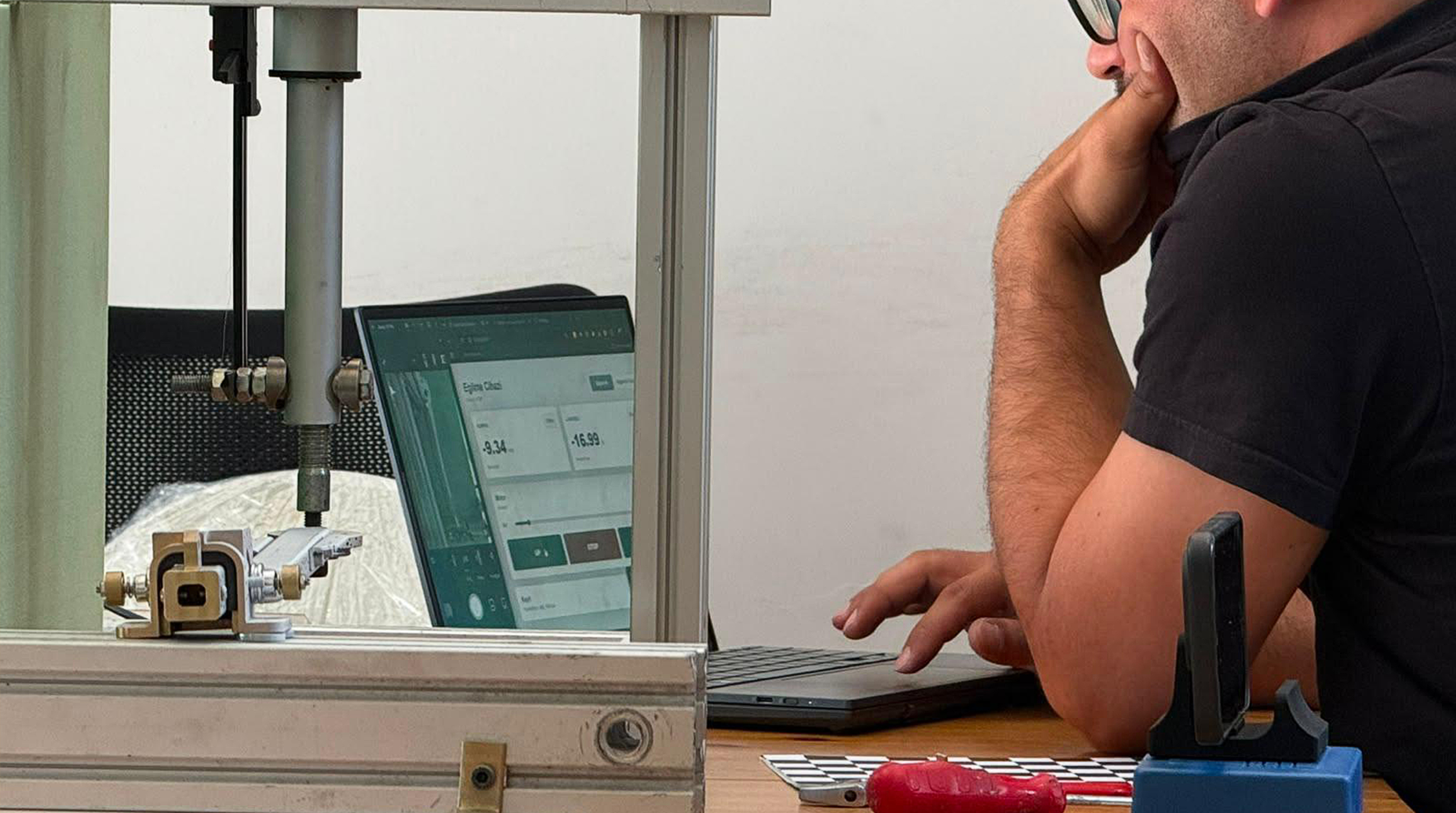
In composite materials, knowing only the fiber type or total thickness is not enough to predict a part's actual behavior. Fiber orientation, resin ratio, cure condition, void content, connection details and production repeatability all directly affect mechanical performance. Tulkas developed its modular structural and fatigue test device in 2020 to support the design decisions of the propellers and special composite parts it develops with its own measurements.
The purpose of the device was not just to load a final part to failure, but to compare different material and layup options within the same test setup, observe changes in stiffness, and monitor performance under repeated loads.
The developed system was designed to be adaptable, with interchangeable fixtures, to three-point bending, two-point loading, tension and compression tests. Being able to adjust load application points for different sample sizes and part geometries turned the device into an R&D tool not limited to standard coupon testing.
Force-deformation relationships were tracked via a load cell and displacement measurement. This made it possible to obtain data not just on a sample's failure load, but on its stiffness under load, linear behavior region, permanent-deformation tendency and the point where damage begins.
Propellers, rotor blades and load-carrying composite parts are exposed over their service life not to a single maximum load, but to numerous repeated loads. For this reason, the test device was developed with a control structure capable of applying cyclic motion between specified load levels. During fatigue testing, reductions in stiffness, surface damage, delamination or changes at the connection region could be monitored.
This capability provided early data on how a design that appears adequate under a one-time static test would behave over long-term use. When choosing between different ply sequences or production parameters, not just the initial strength value but repeated-load performance became a comparison criterion.
Developing the test device in-house allowed Tulkas to build a faster feedback loop between sample preparation and measurement. After a new layup plan was produced, samples could be tested without delay; results could be fed into the next design and production trial.
The system was built not to replace accredited certification tests, but for R&D, process development, preliminary validation and cross-product comparison. With this infrastructure, Tulkas made its composite design decisions more measurable, while gaining a level of readiness to move into projects requiring external testing with more mature samples.
You can plan an in-house preliminary validation and comparative test approach with Tulkas for your composite material, layup or part design.