2022
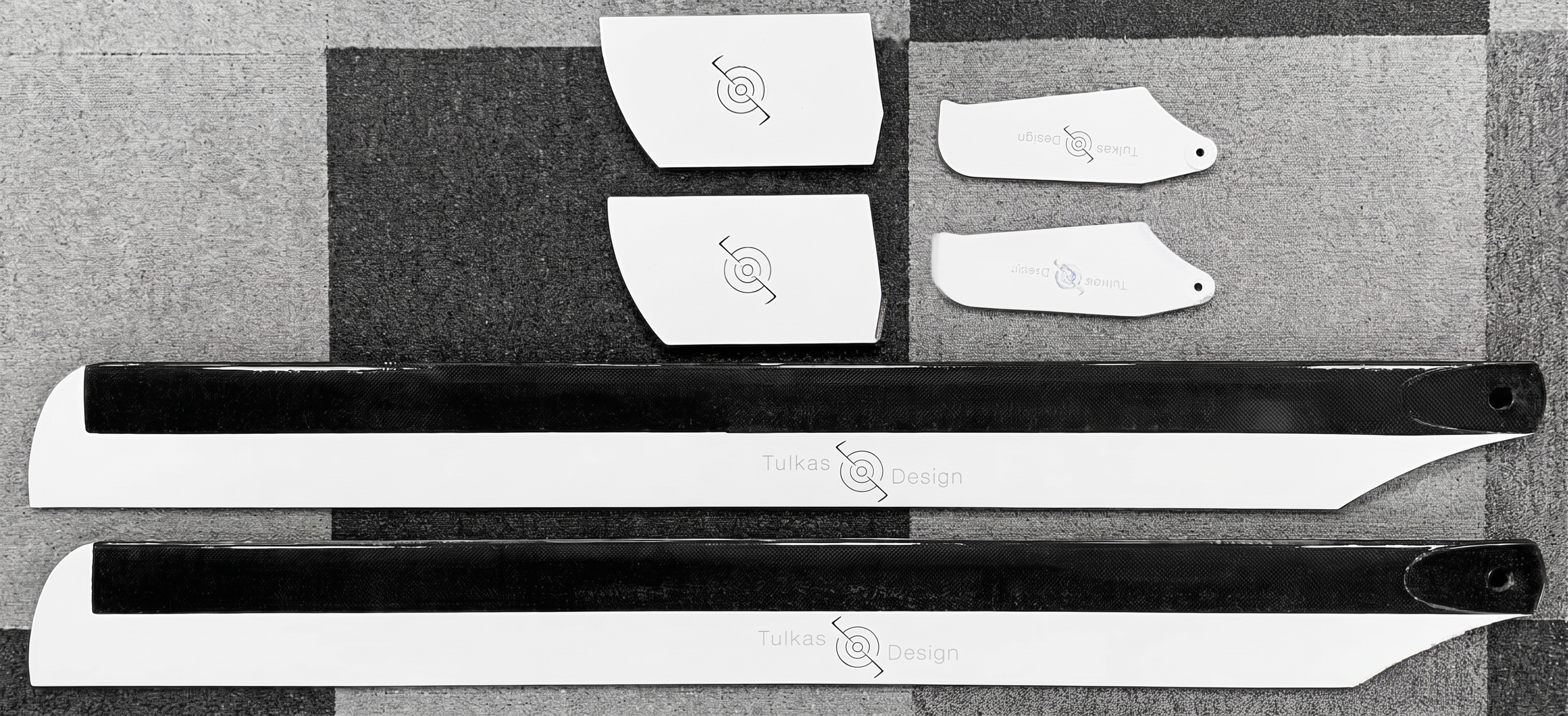
Rotor systems require combining aerodynamic efficiency, low mass, high stiffness and fatigue resistance within the same structure. Tulkas Mühendislik carried the composite manufacturing and balancing experience it gained on unmanned aerial vehicle propellers into a larger-scale helicopter rotor blade prototype.
In this work, as much attention was given to how loads would be carried from the root connection along the blade span as to the blade's outer aerodynamic geometry. Since correctly producing only the outer surface of a composite rotor blade is not enough, the load-carrying plies, local reinforcements, internal structure and connection regions were all evaluated together.
During operation, a rotor blade is exposed to centrifugal force as well as flapwise bending, edgewise bending and torsional loads. Tulkas configured the orientation of the carbon fiber plies to withstand all of these loads together. Plies running along the blade span carried the main tension and bending loads, while angled plies were used for torsional stiffness and shear loads.
Local reinforcements were planned at the root region so that load transfer would not create abrupt cross-section changes, so that connecting elements would not crush the composite structure, and so that dynamic balance would be preserved. The production approach focused on meeting aerodynamic profile tolerances and structural requirements together within the same mold and layup plan.
A mold infrastructure preserving surface quality and profile accuracy was prepared for rotor blade production. Ply placement was broken into controlled steps; resin content, reducing air voids, and maintaining the part's shape during cure were tracked as critical process variables.
After cure, the blade geometry was evaluated for surface continuity, mass distribution and balance. Given that in rotating systems small mass differences can turn into large dynamic forces at high RPM, finishing and balancing operations were carried out as an integral part of production.
The carbon fiber helicopter rotor blade prototype showed that Tulkas can develop manufacturing methodology not only for small UAV propellers, but also for larger, longer and structurally more complex rotating wings. The mold, layup, connection-region and balancing experience gained through the project created infrastructure transferable to different rotor, fan and high-load composite blade applications.
Tulkas treats rotor applications not merely as outer-geometry production, but as a composite engineering problem in which aerodynamic shape, structural load-carrying, manufacturability and testing requirements are solved together.
For rotor, fan or high-load composite blade projects, you can evaluate geometry, load conditions and connection requirements with Tulkas.