2021
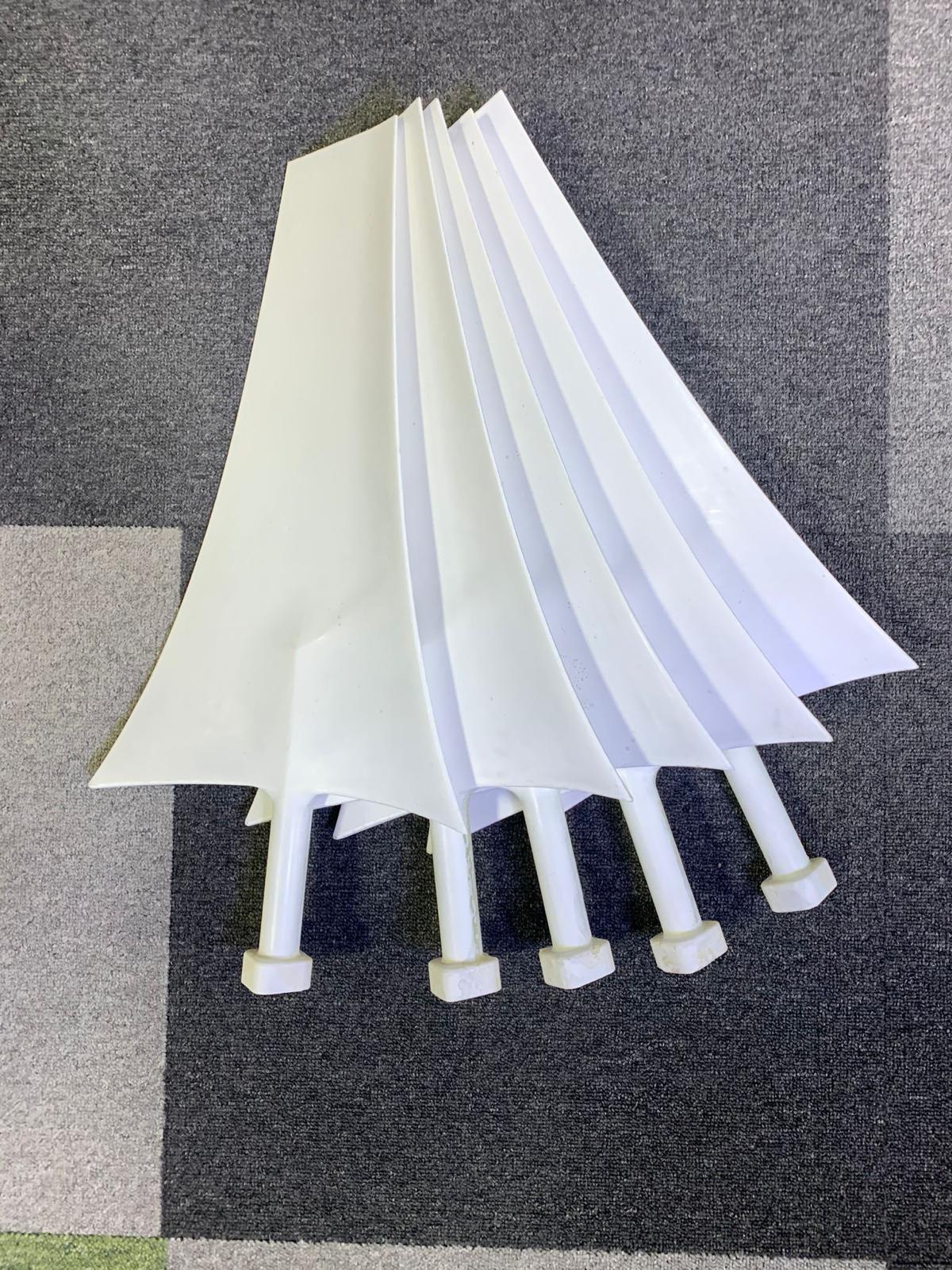
Following the series composite fan blade requirement communicated by Storm Fans, Tulkas focused not just on producing the part, but on establishing the entire process chain needed to make the product repeatable. The work covered the mold approach, material selection, ply preparation, cure, demolding, finishing and balancing steps together.
Using the first samples, the blade's critical dimensions, root connection, surface tolerance and mass distribution were evaluated. The orientation of the composite plies and local reinforcements were arranged to withstand the bending and centrifugal loads generated during operation, while also preventing unnecessary mass increase.
The production recipe defined cutting templates, ply sequences, mold preparation, press or vacuum conditions, cure duration and finishing limits. Making every step controllable reduced operator-dependent variation and helped preserve the same geometry and mass target across successive production runs.
In process optimization, quality consistency was considered as important as cycle time. The production flow was streamlined by planning mold usage, preparing ply kits in advance, organizing process order and placing control points at the correct stages. Improvements were applied by linking the sources of surface and dimensional problems that caused rework to specific process steps.
Because fan blades operate as a set, acceptance of a single part alone was not considered sufficient. A control method was established to track the mass and balance compatibility of parts coming out of production, ensuring blades used in the same fan group were prepared with closely matched properties.
By applying the developed production methodology to series demand, Tulkas became Storm Fans' sole supplier for the relevant efficient composite fan blades in 2021. This development was one of the important steps in Tulkas' transition from project-based prototype production to a series production model carrying ongoing supply responsibility.
The work also showed that the aerodynamic blade, composite layup, mold and balancing knowledge gained in propeller development could be transferred to industrial fan applications. Tulkas built infrastructure capable of adapting composite blade production processes to different operating environments and load conditions based on product requirements.
Tulkas continues to develop sustainable supply solutions by combining geometry with series-production-ready composite processes in fan, propeller and other rotating blade applications.
Tulkas Expands Its Machinery Fleet, Mechanizing Composite Production Processes
In 2023, Tulkas Mühendislik added hot-press molding, vacuum infusion, vacuum bagging, hand layup, SMC, BMC, post-cure and vacuum-assisted polyurethane casting processes to its controlled production infrastructure through additions to its machinery fleet.