2019
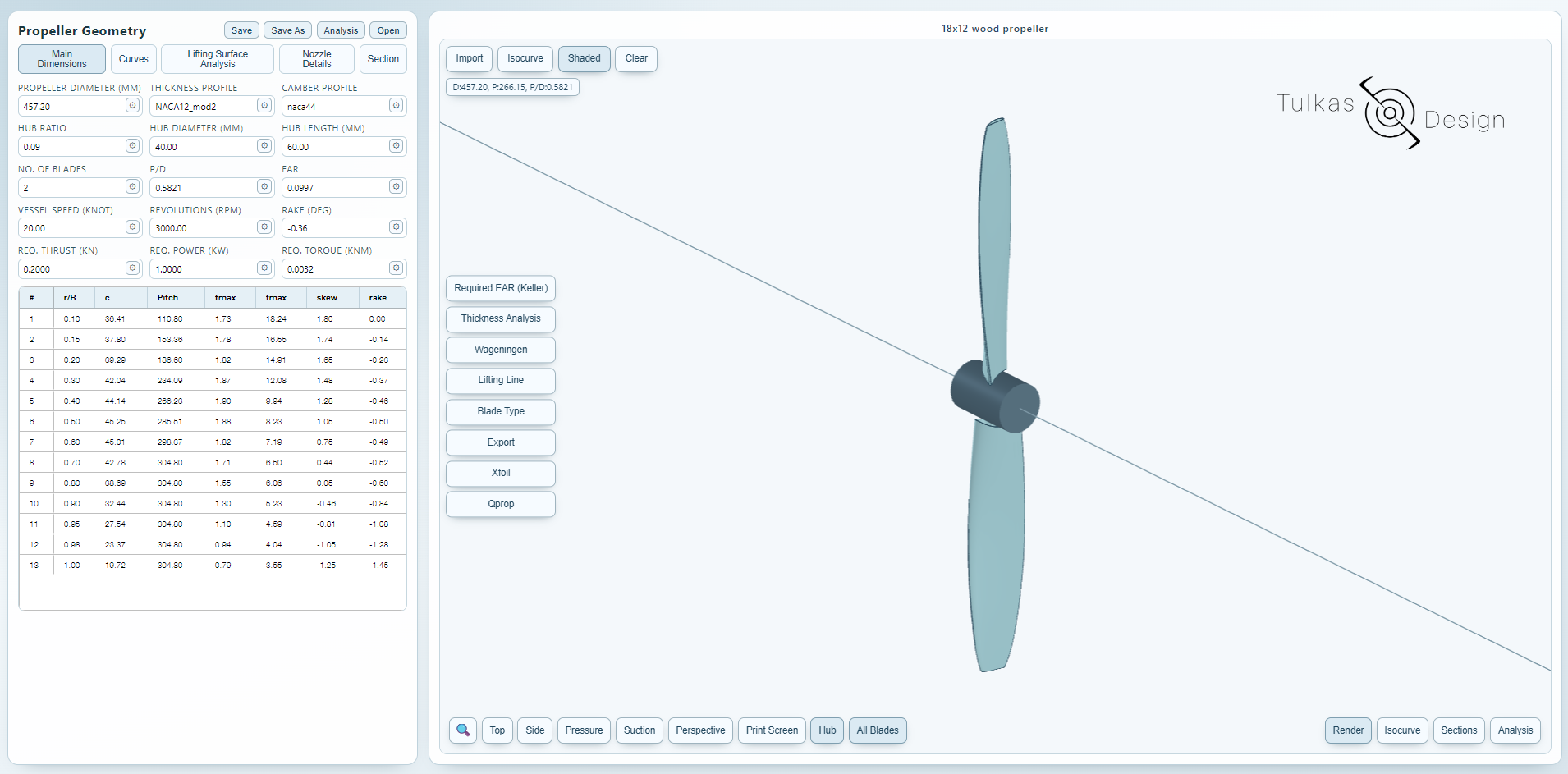
In UAV projects, propeller selection is often made simply by comparing diameter and pitch values. However, products under the same 13x8 or 16x5.4 label can have different profiles, chord distributions, stiffness and production quality, and can show significant performance differences. To avoid limiting propeller geometry to off-the-shelf catalog options, and to design according to the platform's actual operating point, Tulkas developed its own propeller design program in 2019.
The program's core inputs included motor RPM and power characteristics, target thrust, flight speed, propeller diameter limit, blade count and environmental conditions. This turned the design process into an engineering problem evaluating the motor-propeller-platform match, rather than simply selecting one size.
The root, mid and tip regions of a propeller blade operate at different circumferential speeds. For this reason, a single profile and fixed pitch approach cannot deliver the same efficiency in every region. Tulkas' software evaluated local flow speed and load distribution along the blade radius, enabling chord, geometric twist and profile selection to be built up progressively.
The program controlled blade tip speed and the related compressibility and noise risks, while also including a structurally manufacturable cross-section at the root region within the design constraints. This targeted a geometry that was not just theoretically efficient, but could actually be manufactured with a carbon fiber mold.
One of the software's most important contributions was the ability to compare different diameters, pitches and operating RPMs quickly. For a given motor, multiple candidate propellers could be evaluated numerically before being produced, narrowing the design space to fewer, more meaningful options.
The resulting geometry formed the base data to be carried into more detailed flow analysis, 3D modeling and mold design. Results from thrust tests were fed back into the program, making it possible to compare the calculation approach against real production parts.
For Tulkas, the propeller design program was not just a calculation tool, but infrastructure that institutionalized the knowledge learned from developed products. The effect of different profile families, planforms and pitch distributions on performance became reusable in new projects.
Through this software, Tulkas built an engineering approach that could develop a suitable propeller geometry starting from the platform's mission profile, rather than simply recommending a product from an existing mold list. The program later became the first link in the design-validation chain used together with the OpenFOAM-based flow analysis tool and the in-house thrust test system.
You can initiate a platform-specific propeller design study by sharing your motor map, target thrust, flight speed and geometric constraints.