2019
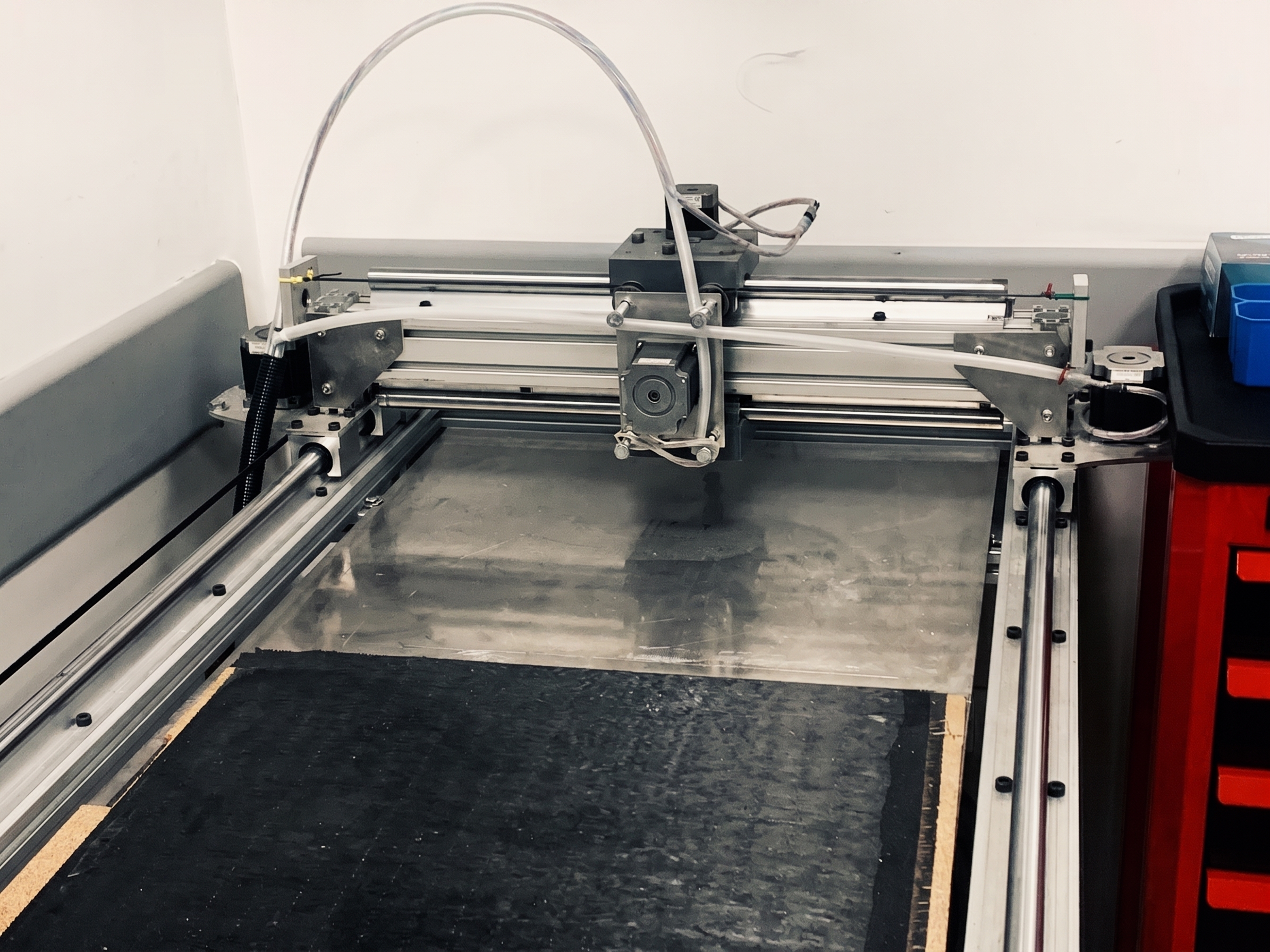
Tulkas developed its own four-axis fiber cutting machine in 2019 to prepare prepreg plies for propellers and different composite structures in a more controlled way. The goal was not just to increase cutting speed, but to be able to transfer the ply plan from the engineering model to the shop floor with the same accuracy.
The machine was built on a four-axis architecture that allows different ply shapes to be cut with coordinated movement. The cutting path was derived from ply geometries prepared in CAD and converted into controlled tool motion. This structure made it possible to prepare curved edges, contours that vary at the root and tip regions, reinforcements around connections, and small details within the same work setup.
Preventing the cutting tool from dragging unnecessarily on the material, avoiding damage to the prepreg surface, and controlled handling of the backing film were among the core focuses of the development process. Motion speed, cutting order and part placement were made adjustable for different material thicknesses and fiber structures.
With the machine, plies could be prepared not one by one but as a kit or set matching what would be used in production. All the plies of a propeller blade or a composite part could be grouped by placement order from a numbered cutting plan. This reduced the risk of using the wrong ply or mixing up ply orientation during lamination.
Digital nesting plans also helped position parts more efficiently on the material. Controlling scrap, particularly for costly prepreg materials, provided an advantage that reduced not only production expense but also the risk of mixing material from different batches.
The four-axis fiber cutting machine was one of Tulkas' early efforts demonstrating its ability to design the equipment it needs according to its own production process, rather than buying it ready-made. The machine provided infrastructure adaptable to preparing ply kits used in propellers, rotor blades and different molded composite parts.
The precision cutting capability later became one of the core inputs for the series production methodologies developed afterward. Matching standard cutting files with production recipes helped preserve ply geometry and fiber orientation when moving from samples to series production.
Tulkas can develop not only the mold and part design for special composite products, but also the special machinery and process equipment needed for production, based on product requirements.
Tulkas Optimizes the Composite Fan Blade Production Process for Storm Fans and Becomes Its Sole Supplier
Following demand for series production of efficient composite fan blades, Tulkas Mühendislik developed and optimized its production process and became Storm Fans' sole supplier for the relevant composite fan blades in 2021.